Five Stories, Two Sides, One Week
We break down five major stories — from the Fed’s latest rate cut to DHS vetting, a seized tanker, a new mifepristone suit, and China’s stimulus — and how the right and left are reacting. Clear context, fast takes, and what to watch next.
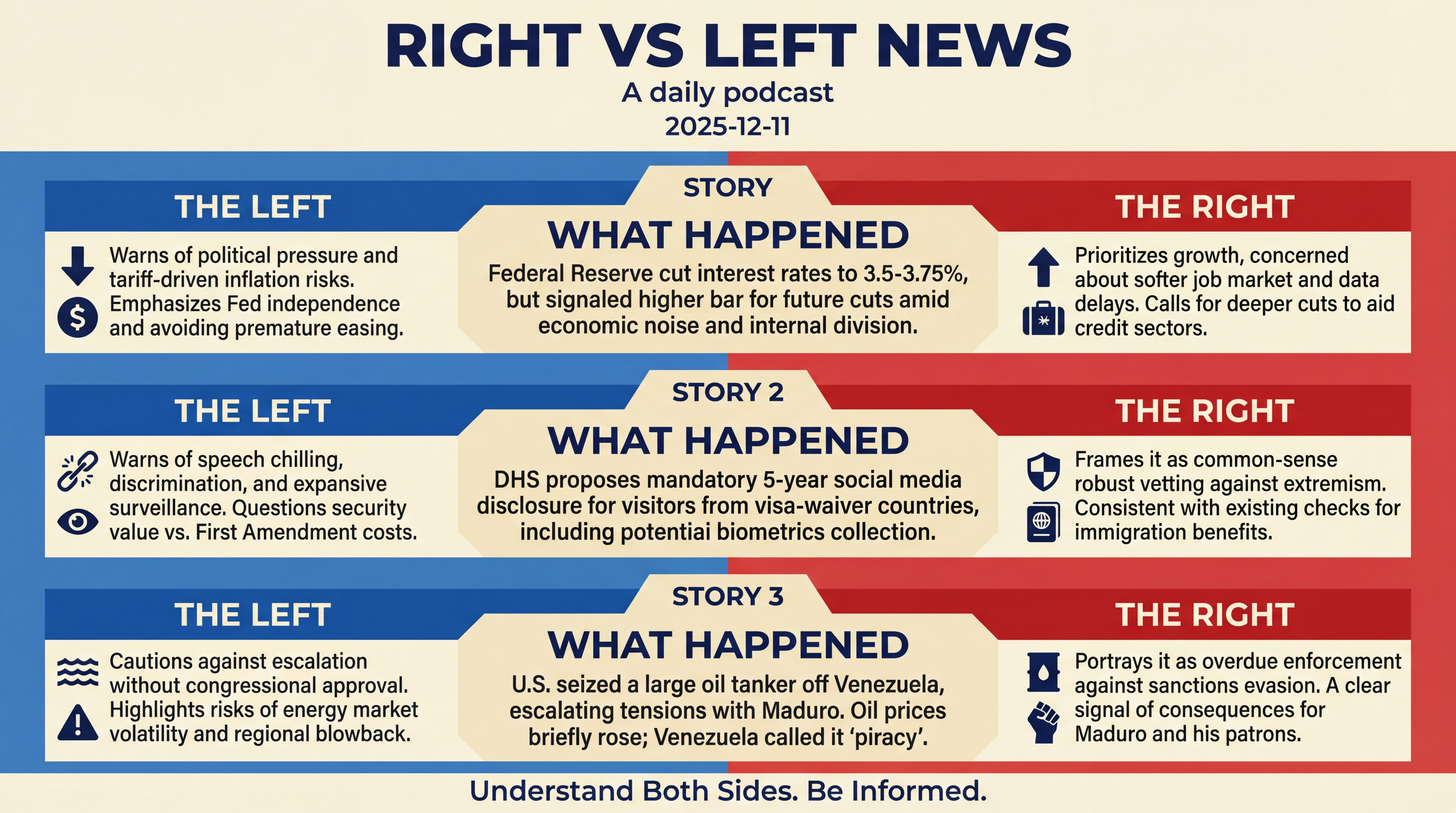
Episode Infographic
Show Notes
Welcome to Right versus Left News—your daily briefing on the stories that matter, told from both sides of the aisle. I'm your AI host - Chris, and each day I bring you the most important political and cultural news, with perspectives from conservative and progressive voices. No spin, no agenda—just the facts and the opinions that shape our national conversation. Let's dive in...
Here’s a quick run-through of today’s five big stories.
The Federal Reserve cut interest rates again, but signaled a higher bar for more cuts amid a noisy economy with delayed data...
The Department of Homeland Security proposed making social-media disclosure mandatory for visitors from visa-waiver countries...
The U.S. seized a large oil tanker off Venezuela’s coast, escalating tensions with Nicolás Maduro...
Texas and Florida filed a fresh lawsuit to roll back the FDA’s approval of the abortion pill mifepristone...
And China’s leadership wrapped its year-end economic conference by pledging more fiscal support next year.
We’ll tackle what happened — and how the right and left are reacting — on each. Here’s where things stand.
[BEGINNING_SPONSORS]
Story one — here’s what happened...
The Federal Reserve cut its policy rate by a quarter point, setting a target range of three point five to three point seven five percent. It’s the third straight cut. The Fed also told its New York trading desk to maintain that range and to buy short-term Treasury bills to keep reserves ample, while noting deep internal divisions about the path ahead. Chair Jerome Powell said the recent inflation overshoot largely reflects one-off tariff effects, and the Fed’s projections show only limited easing ahead. Several officials dissented — one wanted a bigger cut, two wanted no cut.
What’s the right saying?
Conservative and business-friendly voices argue the Fed should prioritize growth and not overreact to tariff-driven price bumps. They highlight concerns about a softer job market, and some say deeper cuts would help credit-sensitive sectors rebound faster and ease stress from the shutdown’s data blackout. Reporting about possible labor-market overcounts also lands on the right as a reason for more accommodation.
And what about the left?
Progressive and mainstream outlets warn that political pressure on the Fed is risky, and that tariffs may keep inflation sticky — so caution is warranted. They note the internal splits and point to Powell’s view that tariff-related inflation is likely transitory but still a headwind, emphasizing the need to protect Fed independence and avoid premature easing that could reignite prices.
Story two — here’s what happened...
DHS is proposing to make five years of social-media history a mandatory part of ESTA — the travel authorization used by citizens of about forty visa-waiver countries to visit the U.S. The draft also contemplates collecting additional contact information, metadata, and, when feasible, biometrics. It opens a sixty-day public comment window before any rule becomes final, and it cites a January twenty twenty-five executive order on vetting.
What’s the right saying?
Security hawks say robust vetting is common sense — especially given concerns about extremist content and the need to screen for terror ties. They frame the step as consistent with broader social-media screening already used for certain immigration benefits and student visas.
And what about the left?
Civil-liberties groups warn this chills speech, invites discrimination, and creates an expansive surveillance dragnet for millions of travelers. Critics underscore the breadth of data fields under discussion and argue that mass social-media screening has little proven security value and big First Amendment costs.
Story three — here’s what happened...
The U.S. seized a large oil tanker — identified in multiple reports as the Skipper — near Venezuela. Video released by U.S. officials showed Coast Guard members boarding from helicopters, and President Trump said the U.S. had just seized a tanker, suggesting the oil would be kept. Venezuela called it international piracy. Oil prices initially ticked up on the news.
What’s the right saying?
The move is portrayed as long-overdue enforcement against a sanctions-evading shadow fleet — a clear signal that Nicolás Maduro and his patrons will face consequences. Coverage stresses renewed resolve after earlier maritime strikes and broader U.S. pressure in the Caribbean.
And what about the left?
Outlets caution that this risks escalation without clear congressional authorization and could spark broader energy-market volatility. They highlight legal questions, regional blowback, and the risk of tit-for-tat moves.
[MIDPOINT_SPONSORS]
Story four — here’s what happened...
Texas and Florida filed a new federal lawsuit seeking to unwind the FDA’s approval of mifepristone — including the original two thousand approval and a newly authorized generic. They argue the agency cut corners on safety and unlawfully expanded access. The case lands in the Northern District of Texas, which has hosted prior challenges. The Supreme Court previously rejected a similar suit on standing grounds, but state-led challenges are pressing on. Civil-liberties and reproductive-rights groups quickly condemned the filing.
What’s the right saying?
Conservatives argue the FDA overstepped and relaxed safeguards. They point to safety disputes and say the courts must rein in what they view as unlawful administrative shortcuts.
And what about the left?
Progressives call it an attempt to ban a medication used in most U.S. abortions, despite decades of safety evidence. They describe the new case as an end-run around science and national access — revived after doctor-plaintiffs lost at the Supreme Court on standing.
Story five — here’s what happened...
China’s year-end Central Economic Work Conference concluded with leaders pledging a proactive fiscal stance in twenty twenty-six — keeping deficits high, issuing more debt, and pairing that with looser monetary tools like reserve requirement or rate cuts. Analysts expect Beijing to target roughly five percent growth while tackling local-government debt and a weak property sector.
What’s the right saying?
China’s continued stimulus and industrial push, the argument goes, demand U.S. vigilance — tighter screening of inbound investment, curbs on capital and tech flows, and firm tariffs and anti-dumping measures. Recent U.S. and European moves to scrutinize investment and supply chains are cited as prudent guardrails as Beijing leans on state-driven growth.
And what about the left?
Analysts stress that global fragility calls for engagement. International bodies have urged China to rebalance toward household consumption, fix property-sector woes, and strengthen the safety net — steps that could lower trade tensions and stabilize demand. The case is that coordinated economic diplomacy beats tariff sparring.
Quick recap...
The Fed cut rates but signaled caution. DHS floated mandatory social-media checks for visa-waiver travelers. The U.S. seized a Venezuelan tanker amid rising tensions. Texas and Florida launched a new mifepristone lawsuit. And China mapped out more stimulus for twenty twenty-six.
We’ll keep watching the data, the courts, and those comment dockets — because the next moves on each could land fast.
That's it for today's episode of Right versus Left News. Remember, understanding both sides isn't about picking a team—it's about being informed. Subscribe wherever you get your podcasts, and join us tomorrow for another balanced look at the day's biggest stories. Until next time, stay curious and stay informed.