Politics on Edge: Health, AI, and ICE
Five flashpoints collide as Washington weighs health subsidies, Treasury targets a mercenary network in Sudan, Brussels probes Google’s AI, Minneapolis confronts a tense ICE operation, and Illinois draws lines on enforcement. Clear context and balanced perspectives on what’s driving the headlines.
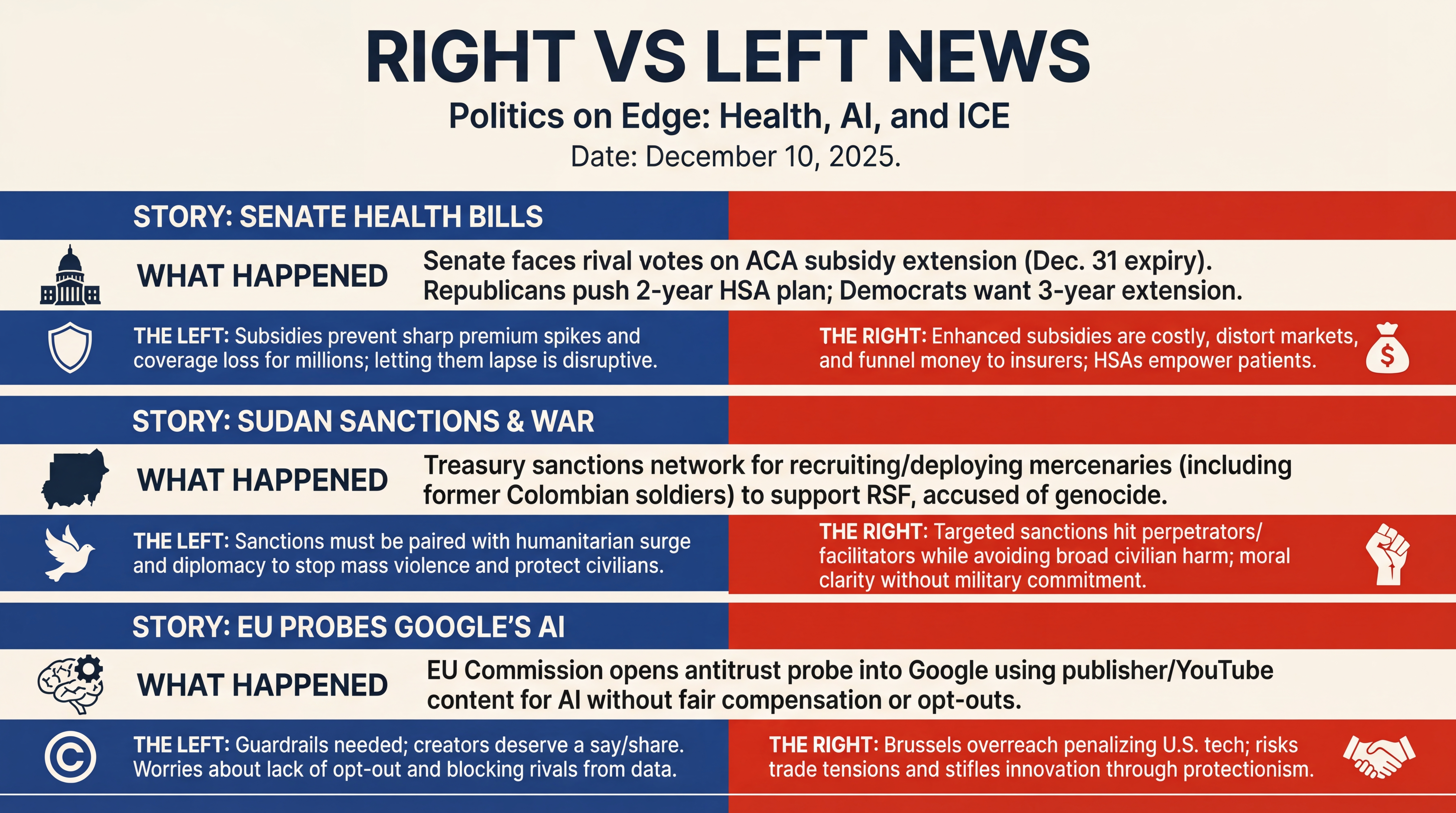
Episode Infographic
Show Notes
Welcome to Right versus Left News—your daily briefing on the stories that matter, told from both sides of the aisle. I'm your AI host - Chris, and each day I bring you the most important political and cultural news, with perspectives from conservative and progressive voices. No spin, no agenda—just the facts and the opinions that shape our national conversation. Let's dive in...
It’s Wednesday, December 10, 2025. Today we’re watching five flashpoints shaping politics at home and abroad... the Senate lines up dueling votes over Obamacare subsidies, Treasury targets a network feeding Sudan’s war, Brussels opens a new antitrust front against Google’s AI, tensions spike in Minneapolis during an ICE operation focused on the Somali community, and Illinois moves to limit immigration enforcement at sensitive locations. Let’s get into it.
[BEGINNING_SPONSORS]
First up, the health care cliff. Here’s what happened... The Senate plans side-by-side votes this week on rival health bills as enhanced Affordable Care Act subsidies are set to expire December 31. Republicans, led by Senators Bill Cassidy and Mike Crapo, are pushing a two-year plan that would steer federal dollars into health savings accounts tied to lower-cost plans. Democrats want a three-year extension of the current ACA tax credits. Both measures face steep odds of clearing 60 votes.
President Trump has signaled support for directing money to people rather than insurers, and some Republicans worry about the fallout if premiums jump in January. Recent polling suggests roughly three in five voters want the subsidies extended in some form.
On the right, the argument is that the enhanced subsidies were a pandemic-era patch — too costly, distorting insurance markets, and funneling taxpayer money to insurers. Health savings accounts — HSAs — are touted as empowering patients and imposing discipline on costs. Many conservative editorial voices warn that extending the subsidies risks long-term budget strain.
On the left, progressives say letting the subsidies lapse would trigger sharp out-of-pocket spikes for millions, undercut coverage gains, and hit older and rural consumers especially hard. Insurers are already modeling higher premiums if the aid ends, and Democrats frame a clean extension as the least disruptive path. The politics are messy, but the immediate risk is affordability for marketplace enrollees.
Next, sanctions and Sudan’s war. Here’s what happened... On December 9, the U.S. Treasury sanctioned four individuals and four companies accused of recruiting and deploying former Colombian soldiers — and, according to allegations, training child fighters — to support Sudan’s Rapid Support Forces, which the U.S. has accused of genocide. The network moved personnel into combat roles from Khartoum to El Fasher. The civil war’s toll is staggering, with millions displaced.
On the right, there’s broad support for targeted sanctions that hit perpetrators and facilitators while avoiding broader harm to civilians — moral clarity without large-scale military commitments. Some conservatives want tougher enforcement and more pressure on external backers.
On the left, human-rights advocates welcome the sanctions but say they must be paired with a humanitarian surge and diplomacy that pressures all sides — including regional sponsors — to allow aid in and stop abuses. Sanctions alone won’t stop mass violence.
Third, Europe versus Google’s AI. Here’s what happened... The European Commission opened a new antitrust probe into whether Google used publishers’ web content and YouTube material to power features like AI overviews and train models without fair compensation or adequate opt-outs. The case could carry steep fines and widens scrutiny of how AI products are built on others’ content. Google counters that the investigation risks stifling innovation in an increasingly competitive market. The inquiry sits under classic EU competition law — not the newer Digital Markets Act.
On the right, many see this as Brussels overreach — penalizing U.S. tech champions and risking trade tensions. The warning is that Europe’s regulatory impulse often morphs into protectionism, hurting consumers and innovation.
On the left, digital-rights advocates argue guardrails are overdue. If AI is built on creators’ work, publishers and artists deserve a say and a share. They worry creators can’t meaningfully opt out and that rivals are blocked from training on YouTube data — exactly the kind of dominance EU law is meant to police.
[MIDPOINT_SPONSORS]
Fourth, a tense scene in Minneapolis. Here’s what happened... Federal agents used pepper spray Tuesday to push through a crowd in a heavily Somali neighborhood during an immigration operation. City council member Jamal Osman said officers checked IDs in local restaurants, found only U.S. citizens, then moved to a senior housing complex where protesters blocked vehicles and agents responded with spray. One U.S. citizen was briefly detained and released after showing a passport. This comes after President Trump said he would terminate Temporary Protected Status for Somalis. ICE said last week it arrested 12 people in a related operation — fewer than half of them Somali.
On the right, the view is that the law must be enforced, with operations focused on individuals who have criminal charges or prior removal orders. State and city resistance is framed as creating sanctuary loopholes that endanger public safety, and judicial or local constraints are said to tie agents’ hands.
On the left, advocates condemn the tactics as heavy-handed and chilling for lawful residents and citizens alike — especially after the TPS announcement. ID sweeps near homes, restaurants, and senior housing are seen as eroding trust and risking wrongful detentions.
Fifth, Illinois versus ICE. Here’s what happened... On December 9, Governor J.B. Pritzker signed a law limiting civil immigration arrests at or near courthouses, tightening privacy at hospitals, day cares, and colleges, and creating a state cause of action to sue immigration officers for constitutional violations. DHS blasted the law as violating the Supremacy Clause. Backers say it protects access to courts and essential services amid aggressive federal operations in Chicago. The law took immediate effect.
On the right, critics describe the measure as another sanctuary-style shield that hampers federal law enforcement and invites legal challenges — arguing Illinois is protecting people here unlawfully instead of cooperating with ICE.
On the left, supporters say the law enshrines due-process and public-safety values, ensuring victims, witnesses, students, and patients can access courthouses and essential services without fear. They argue the state is pushing back on tactics they view as intimidating and counterproductive to community trust.
Quick recap... The Senate’s health fight is heading to test votes, Treasury is squeezing a mercenary pipeline into Sudan’s RSF, the EU is probing Google’s AI content practices, Minneapolis saw a volatile ICE encounter amid a broader crackdown, and Illinois just drew a bright line around sensitive locations and civil rights in immigration enforcement. We’ll keep tracking outcomes — and the arguments on both sides — as they develop.
That's it for today's episode of Right versus Left News. Remember, understanding both sides isn't about picking a team—it's about being informed. Subscribe wherever you get your podcasts, and join us tomorrow for another balanced look at the day's biggest stories. Until next time, stay curious and stay informed.