Courts, Cash, Wind, and Civic Space
From the Supreme Court's campaign spending fight to wind energy, civic freedoms, an FBI kneeling lawsuit, and a Tufts visa ruling — we break down what happened and why it matters. Balanced context and quick insights to keep you informed.
Episode Infographic
Show Notes
Welcome to Right versus Left News—your daily briefing on the stories that matter, told from both sides of the aisle. I'm your AI host - Chris, and each day I bring you the most important political and cultural news, with perspectives from conservative and progressive voices. No spin, no agenda—just the facts and the opinions that shape our national conversation. Let's dive in...
It’s Tuesday, December 9th. Here’s what’s ahead: the Supreme Court hears a case that could upend how political parties coordinate spending with candidates... a federal judge knocks down President Trump’s halt on wind permits... a global watchdog downgrades America’s civic freedoms... a group of former FBI agents fired for kneeling during 2020 protests sue to get their jobs back... and a federal judge orders the government to restore the student-status record of a Tufts PhD student whose visa was revoked over a pro-Palestinian op-ed. Let’s dig in.
[BEGINNING_SPONSORS]
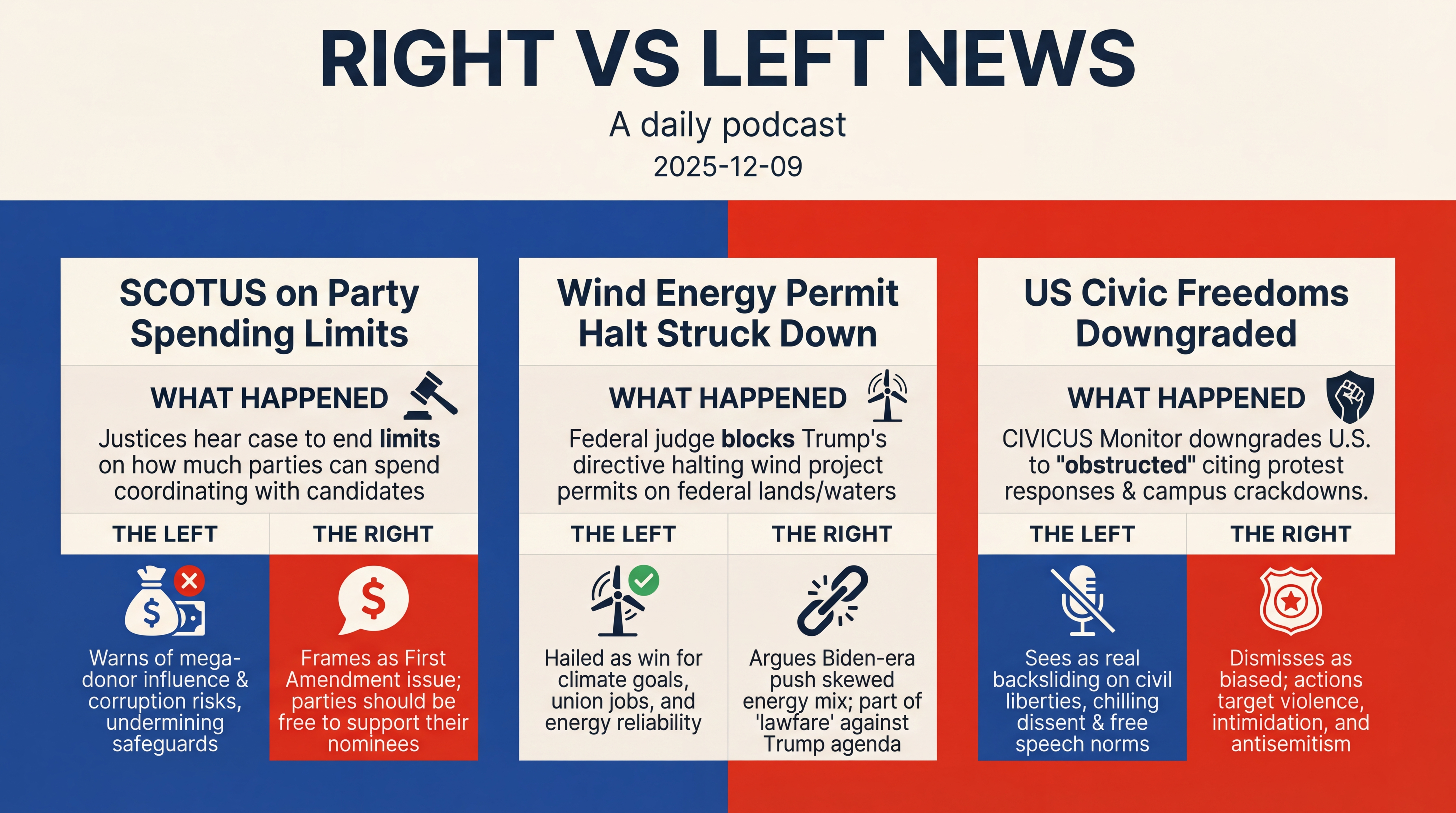
First up, the Supreme Court. Here’s what happened... The justices heard arguments in a Republican-backed challenge seeking to end long-standing limits on how much party committees can spend in coordination with their own candidates.
Those limits—set under federal law and upheld by the Court in 2001—range from roughly $63,600 for many House races to nearly $4 million for a California Senate contest.
A court-appointed lawyer suggested dismissing the case as moot because the FEC no longer plans to enforce the limits, but the conservative majority signaled interest in revisiting the precedent. A decision is likely by June.
Now, what’s the right saying about this? Conservatives frame the case as a First Amendment question... parties should be free to help their own nominees without arbitrary caps. GOP campaign arms argue the limits cripple parties while super PACs and outside groups face fewer constraints — and they welcome the Court’s review as a chance to strengthen party organizations.
And what about the left? Campaign-finance reformers warn that scrapping these limits would open a new pathway for mega-donors to route large checks to candidates through party committees — undermining anti-corruption safeguards. Legal analysts note the 2001 precedent treated coordinated party spending much like a contribution, which can be limited to prevent quid pro quo corruption.
Next, energy policy meets the courts. Here’s what happened... A federal judge in Massachusetts struck down President Trump’s day-one directive halting most permitting and leasing for wind projects on federal lands and waters, calling it arbitrary and capricious.
Seventeen states and Washington, D.C., argued the freeze jeopardized billions in investment and grid reliability. The ruling could restart stalled projects like New York’s Empire Wind — and others.
Now, what’s the right saying about this? Supporters of the halt argue the Biden-era push for wind gave preferential treatment that skewed the energy mix, and they see the court ruling as part of blue-state lawfare against Trump’s energy-dominance agenda. They also point to industry cost overruns to question offshore wind’s economics.
And what about the left? Democrats and clean-energy advocates call it a win for consumers, union jobs, and climate goals — arguing the blanket halt lacked legal rationale and threatened reliability just as demand rises. Restoring predictable permitting, they say, lets projects compete on the merits and helps unlock supply-chain investments.
Third, a civic-freedoms score that’s raising eyebrows. Here’s what happened... The CIVICUS Monitor downgraded the United States from narrowed to obstructed, citing sweeping executive actions, militarized protest responses, pressure on journalists, and crackdowns on campus activism — especially around Gaza and immigration. The group says only about seven percent of the world’s population now lives in countries with open or relatively open civic space.
On the right, many conservatives dismiss CIVICUS as ideologically biased and argue the U.S. response — visa reviews, campus discipline, and law-and-order deployments — targets violence and intimidation, not peaceful speech. They point to visa revocations for foreign students linked to pro-Hamas disruptions as necessary to protect safety and combat antisemitism.
And what about the left? Civil-liberties advocates say the downgrade reflects real backsliding: mass visa actions against protesters, federal deployments to police demonstrations, and pressure on media and universities. They argue these trends chill dissent and conflict with First Amendment norms — and they note that courts have begun pushing back in specific cases.
[MIDPOINT_SPONSORS]
Fourth, an internal fight at the FBI goes public. Here’s what happened... Twelve former agents fired in September for kneeling during a June 2020 racial-justice protest filed suit seeking reinstatement, back pay, and damages.
They say kneeling was a de-escalation tactic when they lacked riot gear and were outnumbered — an approach earlier reviews found non-political — while terminations ramped up after Kash Patel became FBI director.
On the right, some argue that kneeling in FBI gear blurred lines between law enforcement and political protest, undermining neutrality. Supporters of the dismissals say agencies must avoid even the appearance of partisanship.
And what about the left? Civil-liberties advocates and many former agents see the firings as political retaliation amid a broader purge, noting the FBI Agents Association condemned the moves and that internal probes previously found no wrongdoing tied to the kneeling. They say the lawsuit will test whether federal personnel protections still have teeth.
Finally, a student-visa case with free-speech stakes. Here’s what happened... A federal judge ordered the government to immediately reinstate the SEVIS student-status record of Rumeysa Öztürk, a Turkish PhD candidate at Tufts.
ICE revoked her visa and detained her for 45 days after she co-authored a campus op-ed critical of the university’s stance on the Gaza war; the judge found the termination of her record irrational and likely unlawful under the Administrative Procedure Act, which had barred her from paid campus work.
On the right, officials have defended sweeping visa reviews and revocations tied to campus disruptions as a national-security and public-order tool — arguing visas are a privilege, not a right, and that deportations are warranted for those supporting terror groups or engaging in intimidation.
And what about the left? Free-speech groups, the ACLU, and many academics say the case exemplifies retaliatory use of immigration power to chill lawful expression — especially against foreign students — and they welcome the court’s intervention as a guardrail for First Amendment values.
Quick recap... The Supreme Court may reshape how parties fund candidates; a judge revives wind-energy permitting; a watchdog says U.S. civic space is slipping; ex-FBI agents challenge their firings; and a Tufts scholar wins back her student status. Different listeners will cheer different outcomes — but understanding both sides is how we keep the conversation going.
That's it for today's episode of Right versus Left News. Remember, understanding both sides isn't about picking a team—it's about being informed. Subscribe wherever you get your podcasts, and join us tomorrow for another balanced look at the day's biggest stories. Until next time, stay curious and stay informed.