Pay Raises, Farm Aid, and Quiet Signals Abroad
We break down a massive defense bill with troop pay raises, a fresh farm aid package, and a subtle shift in North Korea policy — plus deportation flights to Iran and Europe’s push to cut red tape. Clear context from both the right and the left, and what these moves could mean next.
Episode Infographic
Show Notes
Welcome to Right versus Left News—your daily briefing on the stories that matter, told from both sides of the aisle. I'm your AI host - Chris, and each day I bring you the most important political and cultural news, with perspectives from conservative and progressive voices. No spin, no agenda—just the facts and the opinions that shape our national conversation. Let's dive in...
Here's the quick rundown for Monday, December 8, 2025... Congress rolled out a 901 billion dollar defense policy bill with troop pay raises, Ukraine aid, and a slate of policy riders. The White House is expected to unveil a 12 billion dollar farm aid package as commodity prices sag. In foreign policy, a new U.S. security roadmap drops explicit mention of North Korea's denuclearization, fueling talk of diplomacy in 2026. On immigration, Iran says a second U.S. deportation flight with 55 nationals has departed. And in Europe, a draft plan would relax some environmental reporting requirements for industry as part of a broader push to cut red tape.
[BEGINNING_SPONSORS]
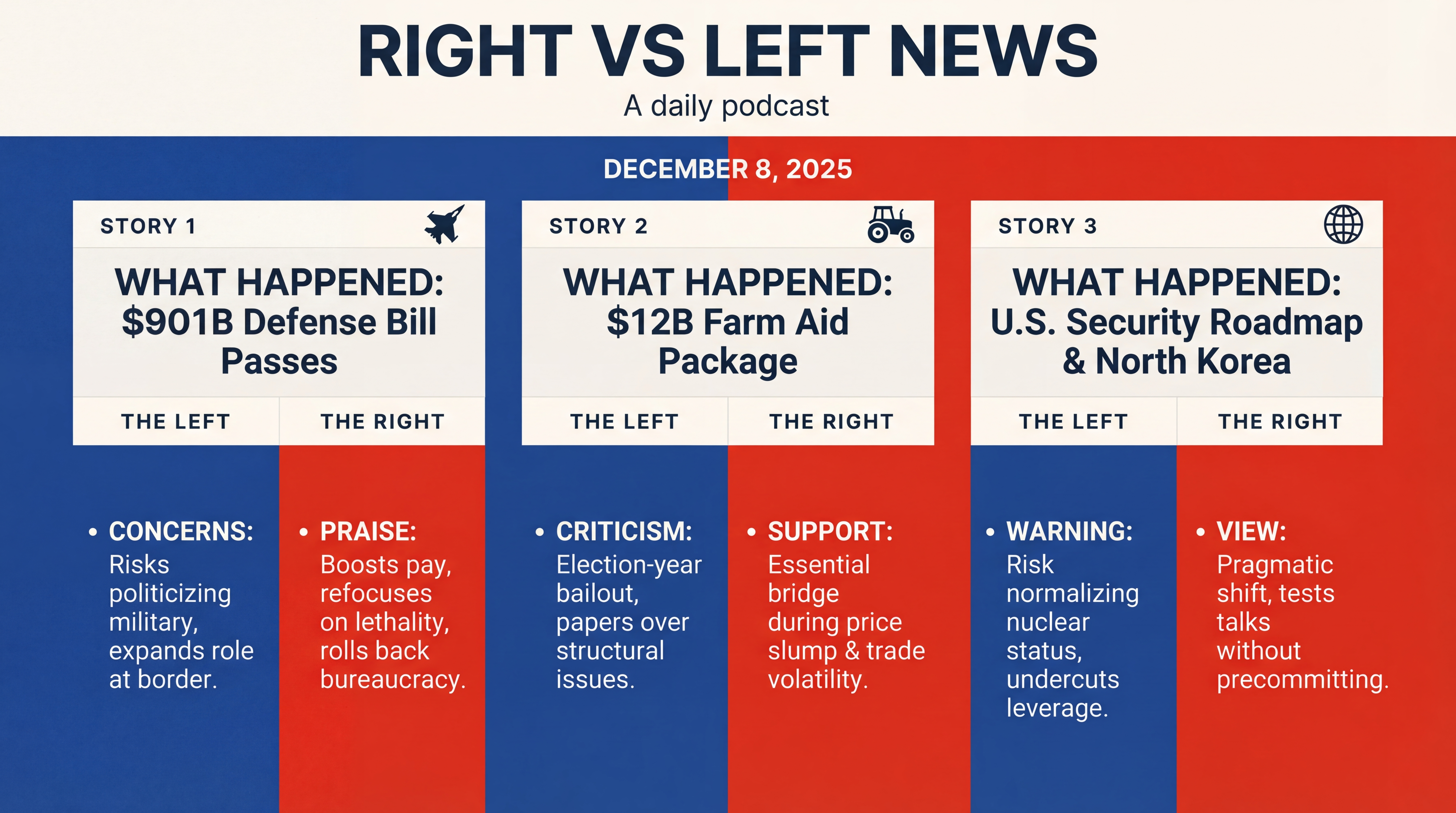
Congress has unveiled the National Defense Authorization Act for the next fiscal year — roughly 901 billion dollars. It includes a 4 percent pay raise for enlisted troops, about 400 million dollars in military aid for Ukraine, limits on Pentagon diversity programs, and guardrails that would make any rapid drawdown of U.S. forces in Europe more difficult. It also repeals old Iraq war authorizations. Negotiators emphasize measures aimed at countering China, support at the border, and investments in the industrial base — while contentious fights over housing and I V F coverage were left out.
From the right... conservative outlets highlight the tougher line on China, the pay raise, and the rollback of the D E I bureaucracy as course corrections that, they say, restore a warrior ethos and refocus on lethality and readiness. They underline new tech bans tied to Chinese supply chains, expanded counter drone authorities, and support for National Guard deployments at the border — framing these as overdue national security wins.
From the left... progressive voices worry the bill hardwires culture war policies into defense, risks politicizing the ranks by targeting D E I, and expands the Pentagon's role at the border without addressing humanitarian concerns. They also note provisions that limit rapid troop withdrawals even as the topline grows — arguing that Congress is restraining some executive impulses while still inflating the budget. Opinion writers warn that the campaign against D E I in Defense Department schools narrows educational resources for military families, and some analysts point to constraints on Europe drawdowns as a rare congressional check on the White House.
The administration is expected to announce roughly 12 billion dollars in farm aid — described by the USDA as a short-term bridge to help producers facing low prices and trade disruptions. Treasury Secretary Scott Bessent and Agriculture Secretary Brooke Rollins are expected to join the rollout. The package would reach cattle, grain, soybean, cotton, and potato producers. Overall farm payments this year are on track to be among the highest since the 1930s, driven by disaster relief and economic assistance.
On the right... farm-state Republicans and the American Farm Bureau have pushed for swift relief, arguing that export volatility, lingering tariff frictions, and higher input costs are squeezing producers ahead of spring decisions. Their market analysis says direct payments are cushioning a weak price environment and disaster losses — even as many producers watch for timing details to keep operations afloat.
On the left... critics call it an election-year bailout that papers over structural problems — tariff blowback, concentrated meatpacking, and immigration limits that worsen labor shortages. They point out that past tariff rounds hit small farms hardest, and that freezes in climate programs and USDA staffing cuts have left some farmers without promised support — evidence, they argue, that ad hoc checks cannot replace consistent policy. The White House is also probing ways to lower beef prices, potentially via more imports — a flashpoint for small ranchers and unions.
Overseas, the new U.S. security roadmap drops explicit mention of North Korea's denuclearization — a notable shift after two decades of strategy documents. Analysts say the omission could be deliberate... creating space for talks with Kim Jong Un in 2026 under a banner of flexible realism, even as Washington and Seoul insist denuclearization remains the goal. South Korea's president has publicly praised Trump's pragmatism and voiced hope for renewed dialogue.
From the right... some see pragmatic sequencing — strengthen allied deterrence, keep pressure on Pyongyang, and test talks without precommitting to maximalist language that has stalled diplomacy before. Supporters also point to warming ties between Seoul and Washington, and the possibility of a leader-level bargain, as reasons to explore an opening.
From the left... analysts warn that softening the denuclearization frame risks normalizing North Korea as a nuclear state and undercutting leverage on human rights and nonproliferation. Critics argue that past summits were oversold, and they fear another round of optics without enforceable limits on missiles or warheads.
[MIDPOINT_SPONSORS]
Iran says a second flight carrying 55 Iranian nationals deported from the United States has departed, following a first flight in September. Tehran portrays the returns as routine enforcement. U.S. agencies declined immediate comment. Rights groups warn that deportees — including some reported religious converts — could face persecution upon arrival.
On the right... coverage frames the flights as long overdue enforcement consistent with broader removals, emphasizing that many deportees had exhausted legal avenues. Commentators note Iran's human rights abuses while arguing that firm enforcement deters unlawful entry.
On the left... progressive outlets and faith-based advocates stress humanitarian risk, citing Christian converts and dissidents among those sent back. They argue that the United States has historically protected Iranians fleeing repression and should not facilitate returns to a government with a record of arbitrary detention and executions.
In Brussels, a draft European Commission plan would ease several environmental reporting requirements on industry as part of a drive to cut corporate paperwork by 25 percent by 2029. Proposals would streamline site level management systems and drop some climate alignment plan mandates. Business groups praise the move, while environmental advocates say it weakens accountability even as green targets remain in place.
From the right... pro-market voices applaud Brussels for trimming bureaucracy they say burdens firms without commensurate climate gains. They see a competitiveness play — especially as Europe grapples with high energy costs and slow growth — and a possible model for U.S. regulators considering similar streamlining.
From the left... environmental groups and many center left policymakers warn the draft undercuts transparency on pollution, chemicals, and water use, just when the bloc needs credible data to hit its climate commitments. In their view, weaker reporting risks greenwashing and delays the investments needed for a clean energy transition.
Congress's new defense bill sets pay raises and policy guardrails. Farm aid is poised to land as markets wobble. The security roadmap's silence on North Korea hints at 2026 diplomacy. Deportation flights to Iran ignite a rights debate. And Europe tests how far it can cut red tape without cutting climate credibility. We'll watch what moves from draft to law — and what that means for you.
That's it for today's episode of Right versus Left News. Remember, understanding both sides isn't about picking a team—it's about being informed. Subscribe wherever you get your podcasts, and join us tomorrow for another balanced look at the day's biggest stories. Until next time, stay curious and stay informed.