
Five Flashpoints Reshaping U.S. and World Politics
We break down five fast-moving stories—from the Supreme Court’s Texas map decision and a Western Hemisphere strategy, to AI chip controls, expanded travel bans, and Ukraine talks—and how the left and right are reacting. Clear context, quick analysis, and what to watch next.
Episode Infographic
Show Notes
Welcome to Right versus Left News—your daily briefing on the stories that matter, told from both sides of the aisle. I'm your AI host - Chris, and each day I bring you the most important political and cultural news, with perspectives from conservative and progressive voices. No spin, no agenda—just the facts and the opinions that shape our national conversation. Let's dive in...
Today, we’re tracking five big moves shaping politics at home and abroad.
A late-night Supreme Court decision that lets Texas use a new congressional map. The administration’s National Security Strategy pivot toward the Western Hemisphere. A bipartisan Senate push to block any easing of AI chip exports to China. Homeland Security’s plan to widen the U.S. travel ban to more than thirty countries. And what Moscow calls encouraging — but still unresolved — Ukraine talks with U.S. envoys.
All five broke in the last twenty-four hours, according to reporting from AP, Reuters, and Politico.
[BEGINNING_SPONSORS]
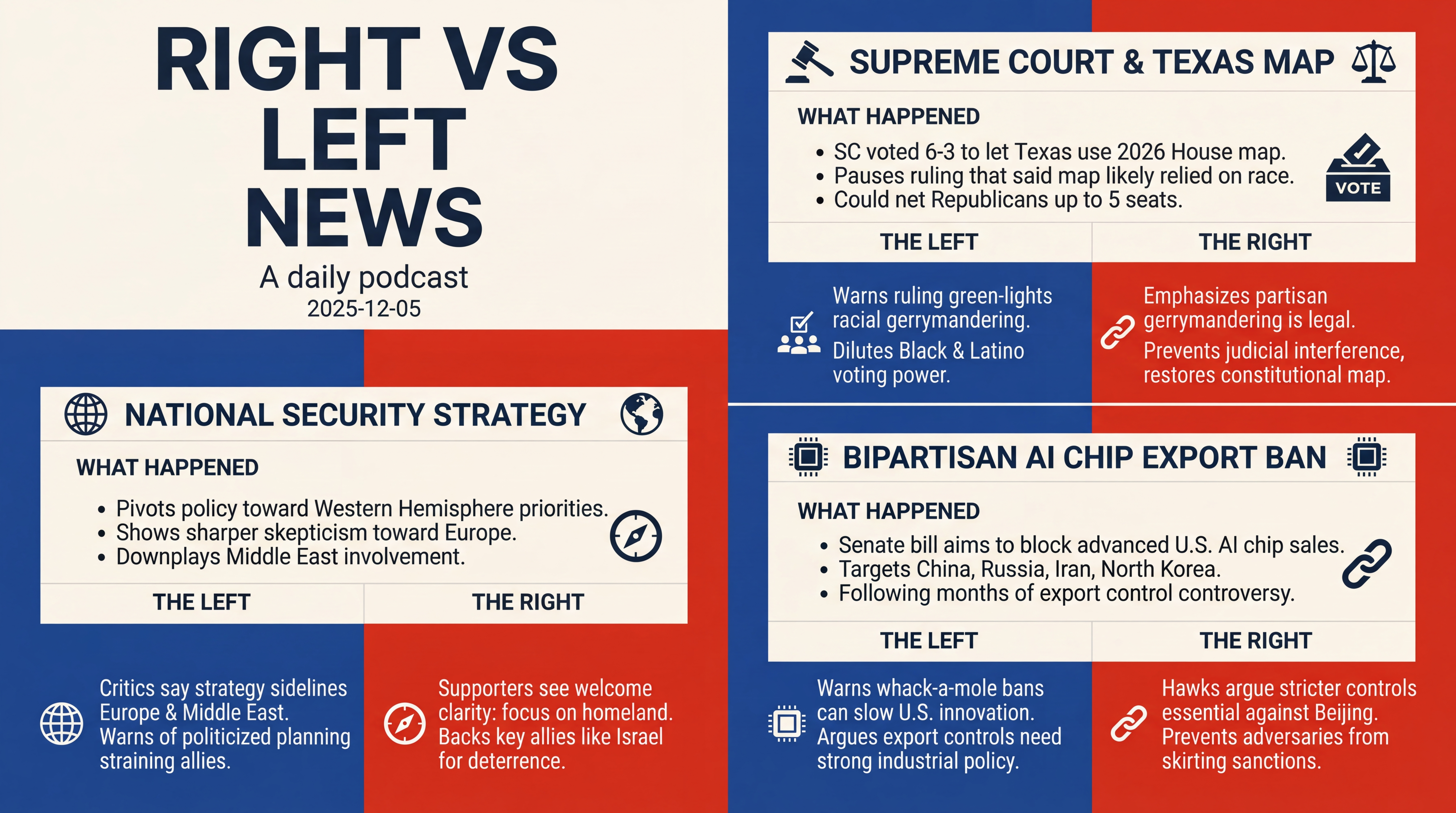
First, here’s what happened. The Supreme Court voted six to three to let Texas use its newly redrawn U.S. House map for 2026, pausing a lower court ruling that said the plan likely relied on race. The unsigned order said the lower court had disrupted an active election cycle — Justice Elena Kagan dissented. The map, backed by Governor Greg Abbott and cheered by the White House, could net Republicans up to five seats, according to AP, PBS, and Reuters.
On the right, conservative outlets emphasize that partisan gerrymandering — while distasteful — remains legal, and argue the Court simply applied that precedent and prevented last-minute judicial interference. Fox News frames the decision as restoring a legislature-drawn map aligned with constitutional principles and voter preferences.
On the left, progressive voices warn the ruling green-lights racial gerrymanders masquerading as partisanship, and will dilute Black and Latino voting power. Coverage highlights Kagan’s warning that many Texans will now be placed in districts because of their race, while Democrats call it an erosion of Voting Rights Act protections.
Next, here’s what happened. The administration released its National Security Strategy — a thirty-three-page blueprint that puts border security and Western Hemisphere priorities near the center of U.S. policy, while showing sharper skepticism toward Europe and downplaying the Middle East. The document nods at China without seeking direct confrontation, and pairs with earlier White House memoranda reorganizing the national security apparatus.
On the right, supporters of an America First posture see welcome clarity — focus on defending the homeland, leaning on regional partners, and backing key allies like Israel for deterrence. Coverage emphasizes deterrence through strong alliances and a heavier homeland focus.
On the left, critics say the strategy sidelines Europe and the Middle East, injects ideological themes into national security, and borrows from conservative think tank wish lists. Reporting has highlighted Heritage-aligned fingerprints in internal guidance, and warned of politicized planning that could strain allies.
Third, here’s what happened. A bipartisan group of senators — led by Republicans Pete Ricketts and Tom Cotton, and Democrat Chris Coons — unveiled legislation to block the Commerce Department from approving sales of advanced U.S. AI chips to China, Russia, Iran, and North Korea for thirty months. The bill follows months of controversy over potential rollbacks to export controls and industry lobbying. Reuters and the Financial Times have the details.
On the right, hawks argue stricter controls are essential because Beijing evades sanctions and repurposes advanced tech for its military and partners. Some point to China enabling U.S. adversaries to skirt sanctions — a backdrop for conservatives who say Congress must hard-lock strict controls.
On the left, many support tough guardrails but warn that whack-a-mole hardware bans can backfire if they slow U.S. innovation or are circumvented. Analyses caution that poorly designed carve-outs or reversals could squander the U.S. edge or push China to self-sufficiency — arguing export controls must be paired with strong industrial policy at home.
[MIDPOINT_SPONSORS]
Fourth, here’s what happened. Homeland Security Secretary Kristi Noem said the U.S. will expand its travel ban list to more than thirty countries, citing vetting and security failures. She previewed the move in a Fox News interview. The broadened restrictions would affect both immigrant and non-immigrant entries. Reuters and NBC affiliates documented her remarks, along with earlier posts calling for sweeping bans after a fatal attack near the White House.
On the right, supporters argue that in an age of terror threats and vetting gaps, tougher entry rules are common sense — temporary pressure that prompts foreign governments to meet U.S. information-sharing standards. The view is that countries failing to cooperate shouldn’t get the benefit of U.S. visas.
On the left, civil rights and immigrant advocacy voices see a discriminatory, overbroad policy — a Muslim ban 2.0 in some coverage — that punishes entire populations for the acts of a few, and invites legal challenges. Reporting highlights backlash to Noem’s rhetoric, and skepticism that mass bans actually improve security.
Fifth, here’s what happened. The Kremlin says talks with U.S. envoys on ending the war in Ukraine were encouraging, claiming President Putin accepted parts of a U.S. proposal — while still insisting on maximalist demands over Donbas. Reuters reports that President Trump called the talks reasonably good, and Washington Post coverage notes Moscow’s continued hard line as Kyiv and European leaders warn against any deal that rewards aggression.
On the right, you’ll hear cautious support for trying to end the war through leverage and diplomacy — pressuring Europe to carry more of the load, and aiming for a ceasefire that reduces U.S. costs. Some Republicans argue that a deal rooted in peace through strength is possible if Moscow faces firm red lines.
On the left, progressives insist any accord must protect Ukrainian sovereignty and avoid appeasement. They echo Ukraine’s own warning for real peace, not appeasement, and point to European skepticism that Putin is negotiating in good faith.
Quick recap... the Court’s Texas map ruling could reshape House math, the new National Security Strategy pivots toward the hemisphere, a bipartisan Senate bill aims to keep top AI chips from China, DHS plans a major expansion of the travel ban, and Ukraine diplomacy inches forward under intense scrutiny.
We’ll keep watching what changes — and what doesn’t — as these stories develop...
That's it for today's episode of Right versus Left News. Remember, understanding both sides isn't about picking a team—it's about being informed. Subscribe wherever you get your podcasts, and join us tomorrow for another balanced look at the day's biggest stories. Until next time, stay curious and stay informed.