Power Plays, Press Rights, and Trade Truces
From a Senate War Powers clash over Venezuela to a push to ban stock trading in Congress, we break down the day’s biggest moves — plus the Times vs. Pentagon press fight, Illinois’s vaccine law, and a U.S. pause on China sanctions. Clear context and perspectives from both sides.
Episode Infographic
Show Notes
Welcome to Right versus Left News—your daily briefing on the stories that matter, told from both sides of the aisle. I'm your AI host - Chris, and each day I bring you the most important political and cultural news, with perspectives from conservative and progressive voices. No spin, no agenda—just the facts and the opinions that shape our national conversation. Let's dive in...
Here’s your quick overview for Thursday, December fourth.
Congress is teeing up a War Powers fight over possible U.S. military action in Venezuela. A bipartisan group in the House is trying to ban lawmakers from trading individual stocks. The New York Times is suing the Pentagon over a restrictive new press policy. Illinois just passed a first-in-the-nation law to issue its own vaccine guidelines. And Washington has reportedly paused sanctions on China’s spy agency to protect a fragile trade truce.
Let’s dive in.
[BEGINNING_SPONSORS]
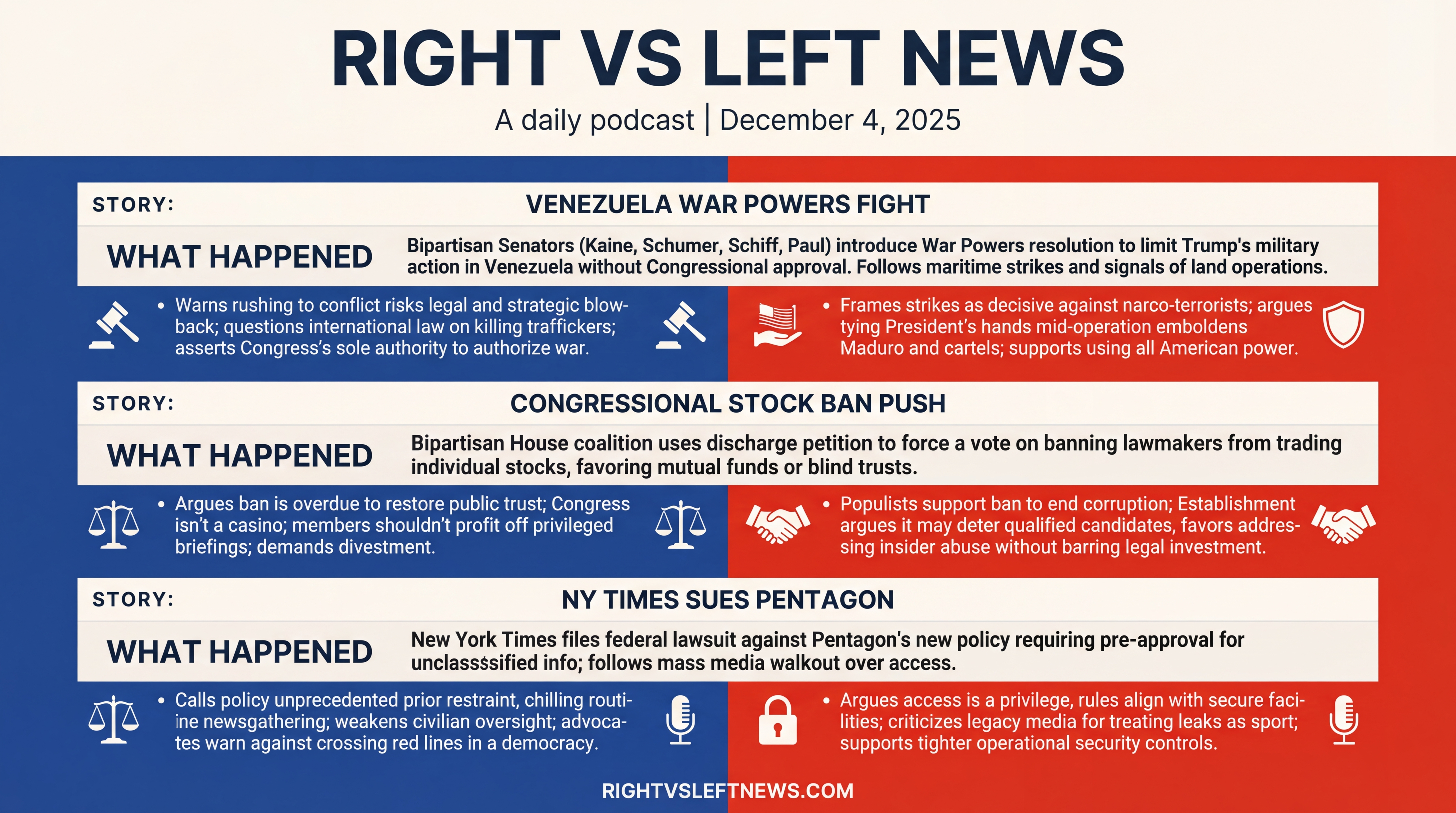
Here’s what happened... A bipartisan group of senators introduced a privileged War Powers resolution to prevent President Trump from launching attacks inside Venezuela without explicit authorization from Congress. Sponsors include Democrats Tim Kaine, Chuck Schumer, and Adam Schiff, and Republican Rand Paul. The move follows months of U.S. strikes on suspected drug smuggling boats, along with new White House signals that land operations could come very soon. Because of Senate rules, the measure must get a vote within days. Deportation flights to Venezuela have also resumed, amid the tense backdrop.
Now, what’s the right saying about this? Some conservative outlets frame the administration’s maritime strikes as decisive action against narco-terrorists, arguing the President will use every element of American power to stop deadly drugs — and that Congress shouldn’t tie his hands mid-operation. National security conservatives also warn that telegraphing limits could embolden Maduro and the cartels.
And what about the left? Editorial voices warn that rushing toward conflict invites legal and strategic blowback. Civil liberties advocates point to analyses questioning whether killing suspected traffickers meets any recognized self-defense standard in international law. Progressives say Congress must reassert its sole authority to authorize war.
Here’s what happened... A bipartisan coalition is trying to force a House floor vote to ban members of Congress and their families from trading individual stocks. Representative Anna Paulina Luna filed a discharge petition to bypass leadership, and the bill has more than a hundred co-sponsors. It would steer lawmakers into mutual funds or blind trusts. Critics say the 2012 STOCK Act’s disclosure rules haven’t stopped conflicts — members made nearly ten thousand trades in 2024 alone. Speaker Mike Johnson has voiced skepticism, arguing an outright ban could deter qualified candidates.
Now, what’s the right saying about this? Populist conservatives have leaned in — some see this as a way to end corruption. Senator Josh Hawley has backed a broad ban. But establishment conservatives echo Speaker Johnson’s view: you can protect against insider abuse without barring legal investment, and heavy-handed rules could shrink the talent pool.
And what about the left? Progressives argue a ban is overdue to restore public trust. They say Congress isn’t a casino — and they’re pressing for divestment or blind trusts. Voters, they argue, won’t accept lawmakers profiting off privileged briefings, and a clean up-or-down vote is the accountability moment.
Here’s what happened... The New York Times filed a federal lawsuit challenging the Pentagon’s new press policy that requires credentialed reporters to promise not to obtain or publish information unless it’s officially authorized — even if the information is unclassified. The policy triggered a mass walkout this fall by outlets across the spectrum. Fox News, the Associated Press, Reuters, and others refused to sign. The Times argues the policy violates the First and Fifth Amendments. The Pentagon says it’s about protecting national security.
Now, what’s the right saying about this? Supporters of the policy argue that access is a privilege — and that the rules simply align headquarters with other secure military facilities: escorts in sensitive areas, visible credentials, and no solicitation of unauthorized material. They say legacy media too often treat leaks as sport; tighter controls don’t bar tough reporting, they just enforce basic operational security.
And what about the left? Critics call this an unprecedented prior-restraint regime that chills routine newsgathering and weakens civilian oversight of the military. Press advocates warn that requiring pre-approval for unclassified information crosses a red line in a democracy — and they’re backing the Times’ case.
[MIDPOINT_SPONSORS]
Here’s what happened... Illinois enacted a first-in-the-nation law allowing the state to issue its own vaccine guidelines, and requiring state-regulated insurers to cover shots recommended by Illinois’s advisory panel — even if federal guidance changes. Governor J.B. Pritzker says the move counters politicization in Washington under HHS Secretary Robert F. Kennedy Jr., including the firing of federal vaccine advisers and potential changes to infant Hepatitis B recommendations. The health insurers’ trade group, AHIP, warns a patchwork could raise costs. The law’s insurance provisions take effect January 1, 2026.
Now, what’s the right saying about this? Critics — including Illinois Republicans and some industry voices — argue it’s a political thumb in the eye to the federal government that may confuse patients and doctors, increase premiums, and undermine nationwide standards. They say vaccine policy should be consistent across states and based on transparent federal science — not fifty different playbooks.
And what about the left? Supporters — including public health groups and Democratic officials — say Illinois is creating a backstop to preserve evidence-based access if federal recommendations are weakened. They argue insurers can adapt, that clarity from a state panel beats national whiplash, and that keeping coverage for routine vaccines is the core consumer protection.
Here’s what happened... The U.S. has paused plans to sanction China’s Ministry of State Security over a long-running cyber espionage campaign known as Salt Typhoon, in order to preserve October’s trade truce between President Trump and President Xi. Under the Busan framework, Washington shelved threatened 100 percent tariffs, while Beijing delayed rare earth export curbs and pledged soybean purchases and fentanyl-related cooperation. The pause also includes holding off on tougher new export controls.
Now, what’s the right saying about this? China hawks warn that trading away cyber deterrence looks like appeasement. They argue the truce rolls back pressure without addressing tech theft or military risks. Editorial voices urge using the window to harden supply chains and keep leverage — not celebrate a deal that mostly avoids escalation.
And what about the left? Center-left outlets note that de-escalation can spare consumers and farmers — but stress it’s a cease-fire, not peace. It’s a step back from the brink that still leaves big issues unresolved: chips, human rights, Taiwan. If anything, they say, the sanctions pause shows the tension between national security aims and tariff politics.
That's it for today's episode of Right versus Left News. Remember, understanding both sides isn't about picking a team—it's about being informed. Subscribe wherever you get your podcasts, and join us tomorrow for another balanced look at the day's biggest stories. Until next time, stay curious and stay informed.