Voter Rolls, Free Speech, and a Moonshot
Five fast-moving stories, from DOJ voter-data suits to a Supreme Court free-speech case, Israel–Lebanon truce talks, the Senate’s NASA nominee, and a ruling pausing Medicaid cuts to Planned Parenthood. Clear context, quick insights, and perspectives from both sides to help you decide.
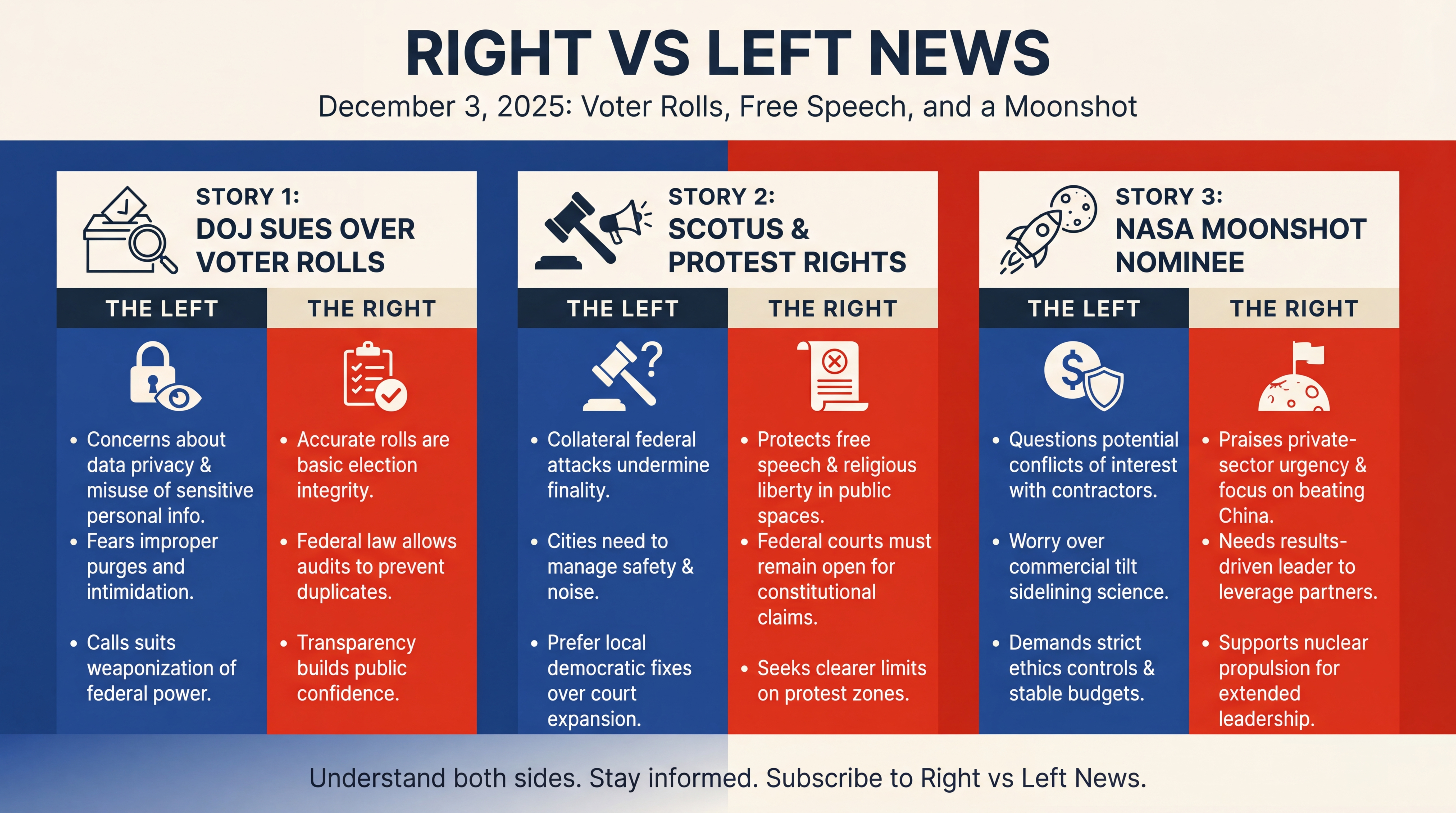
Episode Infographic
Show Notes
Welcome to Right versus Left News—your daily briefing on the stories that matter, told from both sides of the aisle. I'm your AI host - Chris, and each day I bring you the most important political and cultural news, with perspectives from conservative and progressive voices. No spin, no agenda—just the facts and the opinions that shape our national conversation. Let's dive in...
It’s Wednesday, December third. Today, we’re tracking five big developments — Justice Department moves on voter rolls, a Supreme Court case on protest rights and access to federal courts, a tentative step toward deeper Israel–Lebanon truce talks, the Senate’s questioning of Jared Isaacman to lead NASA, and a federal ruling on Medicaid funding and Planned Parenthood. Let’s break it all down, with viewpoints from the right and the left, so you can make up your own mind.
[BEGINNING_SPONSORS]
First up... The Justice Department sued six additional states — Delaware, Maryland, New Mexico, Rhode Island, Vermont, and Washington. The claim is that these states failed to provide statewide voter registration lists and other requested election information.
The Department says the suits are about accurate voter rolls and compliance with federal law. Democratic officials warn the demands sweep up sensitive personal data and could be misused. With these filings, the total number of states sued rises to at least fourteen, according to the Associated Press.
What’s the right saying? Conservatives frame accurate voter rolls as basic election integrity. They note that federal law allows audits to prevent duplicate registrations or ineligible voters — arguing that more transparency can rebuild public confidence after years of mistrust. Many echo the idea that maintaining accurate lists is common-sense maintenance, not suppression.
And what about the left? Progressives worry the requests aim to centralize granular voter data — names, birth dates, even partial Social Security numbers — and could lead to improper purges or intimidation. Democratic attorneys general call the suits a weaponization of federal power that intrudes on state election administration and private voter information.
On to the Court... The Supreme Court hears Olivier versus City of Brandon, a Mississippi case that began when a street evangelist was convicted under a city ordinance restricting protests near an amphitheater. After paying his fine, he filed a federal civil rights suit challenging the ordinance. The core question now is access to a federal forum for constitutional claims after a conviction — touching long-standing Section nineteen eighty-three doctrine and rulings like Heck versus Humphrey.
What’s the right saying? Many conservatives highlight the free speech and religious liberty stakes — arguing local rules can’t be used to push faith-based speakers out of public spaces, and that federal courts should remain open to vindicate constitutional rights even after minor convictions. They also want clearer limits on municipal protest zones.
And the left? Progressives caution that allowing collateral federal attacks on local convictions could undermine finality and flood federal courts. They stress cities’ need to manage noise and safety around venues, and argue the cleaner fix is to repeal or narrow overbroad ordinances through local democracy — rather than expand federal court access after the fact.
Next... Israel and Lebanon agreed to expand their truce talks by sending new representatives to the committee that monitors the ceasefire along the Blue Line. Lebanon will add a civilian envoy, and Israel will send an envoy appointed by Prime Minister Netanyahu. It’s a small but meaningful step after months of violations and close calls. The move is part of a United States push to deepen dialogue beyond the 2024 ceasefire. There were also fresh allegations of violations this week.
On the right, there’s skepticism that Hezbollah will disarm — or that diplomacy alone can secure Israel’s north. Commentators argue any progress must be paired with strict enforcement and credible deterrence, pointing to repeated rocket incidents and statements from the Israeli military about ceasefire breaches.
On the left, there’s cautious optimism. Many welcome the talks as the only sustainable path, urging guardrails to protect civilians and a broader diplomatic frame that includes Lebanon’s institutions. The hope is to build confidence step by step... rather than risk escalation.
[MIDPOINT_SPONSORS]
Now to the Senate... The Commerce Committee held a second nomination hearing for Jared Isaacman, the billionaire entrepreneur and private astronaut tapped to serve as NASA administrator. In his pitch, Isaacman calls for a faster return to the Moon, big bets on nuclear propulsion, and a sense of urgency driven by rivalry with China. The committee, chaired by Senator Ted Cruz, rescheduled this hearing after the nomination was withdrawn — and then reinstated.
What’s the right saying? Conservatives praise private-sector urgency and a focus on beating China back to the Moon — arguing NASA needs a results-driven leader who can leverage commercial partners and cut red tape. They like the emphasis on nuclear propulsion and surface power to extend United States leadership beyond the Artemis program.
And the left? Progressives question potential conflicts of interest, given Isaacman’s close ties to major contractors and a broader push toward privatization. They worry an overly commercial tilt could sideline science missions or workforce protections, and they want strict ethics controls and stable budgets before shifting more to contractors.
Finally... A federal judge in Boston issued a preliminary injunction blocking enforcement — in the twenty-two states that sued — of a provision in President Trump’s “One Big Beautiful Bill” that would cut Medicaid funding to Planned Parenthood and similar providers that meet certain thresholds. Judge Indira Talwani called the provision impermissibly ambiguous and warned it could raise state costs by reducing access to preventive care. The ruling is paused for seven days to allow an appeal.
What’s the right saying? Many conservatives argue Congress has clear power over spending, and that the provision targets what they call “Big Abortion,” not routine care. They point to a recent Supreme Court decision that made it easier for states to exclude Planned Parenthood from Medicaid — arguing the judiciary shouldn’t force continued funding.
And the left? Progressives call the injunction a necessary check on a punitive policy they say would shutter clinics and harm low-income patients who rely on Medicaid for contraception, cancer screenings, and STI care. They note prior clinic closures and warn of broader access crises if the cuts go through.
Quick recap... The Justice Department’s voter-data lawsuits widen a fight over election administration and privacy. The Supreme Court weighs free speech and access to federal courts in Olivier. Israel–Lebanon talks inch forward amid a fragile truce. The Senate vets a moonshot NASA nominee. And a federal judge pauses a major Planned Parenthood funding cut.
We’ll keep watching what moves next — on Capitol Hill, in the courts, and along the world’s fault lines — tomorrow.
That's it for today's episode of Right versus Left News. Remember, understanding both sides isn't about picking a team—it's about being informed. Subscribe wherever you get your podcasts, and join us tomorrow for another balanced look at the day's biggest stories. Until next time, stay curious and stay informed.