
Travel Ban Shockwaves, Tennessee Test, and Fed Signals
A sweeping travel ban proposal, a tight Tennessee special election, and a Supreme Court showdown over donor privacy set the stakes for the week. We also unpack a retroactive corporate tax break and the looming choice for the next Fed chair.
Episode Infographic
Show Notes
Welcome to Right versus Left News—your daily briefing on the stories that matter, told from both sides of the aisle. I'm your AI host - Chris, and each day I bring you the most important political and cultural news, with perspectives from conservative and progressive voices. No spin, no agenda—just the facts and the opinions that shape our national conversation. Let's dive in...
Here's what we're covering today... A call for a sweeping new travel ban after a deadly attack in Washington, D.C. A competitive special election in Tennessee's Seventh District. A Supreme Court case over donor privacy and subpoenas. A new report on retroactive corporate tax breaks. And a signal on who may be the next Fed chair.
[BEGINNING_SPONSORS]
First up, here's what happened... After meeting with President Trump, Homeland Security Secretary Kristi Noem said late Monday she's recommending a full travel ban from countries she claims are 'flooding our nation with killers, leeches, and entitlement junkies.' The statement followed the fatal shooting of a National Guard member in D.C., allegedly by an Afghan national. The White House reposted Noem's message, and DHS is expected to announce details soon. The administration has been reviewing green card holders from 19 countries of concern — though no final list for a ban has been released.
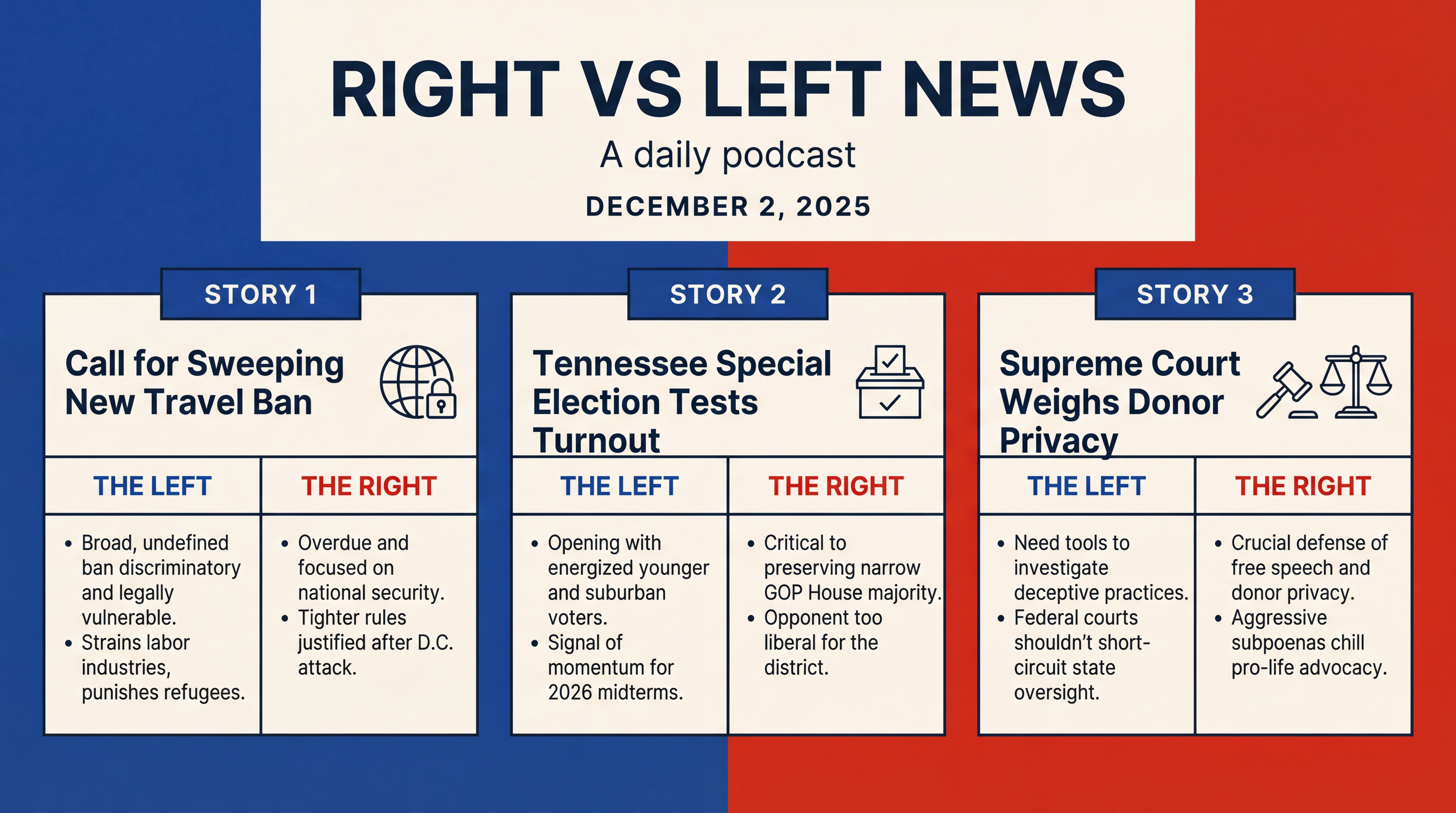
On the right, supporters call the move overdue and focused on national security — pointing to earlier restrictions that survived Supreme Court scrutiny. They argue tighter entry rules are justified after the D.C. attack.
On the left, immigrant-rights advocates and many progressives warn a broad, undefined ban would be discriminatory, legally vulnerable, and economically self-defeating. They say it would strain industries already facing labor shortages, and punish refugees and families with no tie to crime or terrorism. Critics also stress the lack of specifics — and the risk of overreach.
Here's what happened... Voters in Tennessee's Seventh Congressional District head to the polls today in a special election Republicans carried by more than 20 points in 2024 — but both parties say this one looks closer. GOP nominee Matt Van Epps faces Democrat Aftyn Behn, with national figures and funding pouring in. Turnout, and the margin, will be watched as a barometer ahead of the 2026 midterms. A recent Emerson College poll had Van Epps at 48 percent to Behn's 46 — inside the margin of error.
On the right, a seven-figure ad buy from a Trump-aligned group is boosting Van Epps. Republicans frame the race as critical to preserving the GOP's narrow House majority — arguing Behn is too liberal for a district that includes the Nashville suburbs and reaches the Alabama and Kentucky lines.
On the left, Democrats see an opening with energized younger and suburban voters — focusing on affordability and abortion rights, and pointing to strong early vote engagement. Even a narrow GOP win, they say, could still signal momentum for Democrats heading into 2026.
Here's what happened... At the Supreme Court today, the justices hear First Choice Women's Resource Centers v. Platkin — a case testing whether a faith-based New Jersey crisis pregnancy nonprofit can challenge a state subpoena in federal court before being forced to comply in state court. The New Jersey attorney general is probing whether First Choice misled patients, and the subpoena seeks advertising, staff, and donor information. The dispute raises technical questions about ripeness and First Amendment associational rights, and the U.S. solicitor general will argue alongside the nonprofit that federal courts should be open to such pre-enforcement challenges.
On the right, conservative legal groups cast the case as a crucial defense of free speech and donor privacy — arguing that aggressive subpoenas chill pro-life advocacy, and that nonprofits shouldn't have to risk contempt to assert constitutional rights.
On the left, blue-state attorneys general say they need tools to investigate deceptive practices and protect consumers. They stress that First Choice can contest scope and privacy in state court — and that federal courts shouldn't short-circuit state oversight. Abortion-rights advocates see the case as part of a broader fight over regulating crisis pregnancy centers post-Roe.
[MIDPOINT_SPONSORS]
Here's what happened... A new Joint Committee on Taxation report finds corporations will claim about 16 billion dollars this year from a retroactive 100 percent bonus depreciation provision in the GOP's 'One Big Beautiful Bill' — letting firms immediately expense equipment placed in service since January 19, months before the law passed in July. Over ten years, JCT estimates the cost at roughly 363 billion dollars, with modeling suggesting a modest zero point four percent lift to GDP over time.
On the right, pro-growth conservatives argue full expensing boosts investment, productivity, and wages — pointing to evidence that companies are seeing stronger cash flow for capital spending, hiring, and even balance-sheet repair. Some also criticize official dynamic scoring, saying it understates growth effects.
On the left, progressives call the retroactive element a corporate windfall that doesn't incentivize new investment and worsens deficits. They note that much of the benefit flows to the largest firms and could finance buybacks rather than factories — and they point to the sizable revenue cost relative to uncertain job gains.
Here's what happened... President Trump says he's decided whom to nominate as the next Federal Reserve chair to replace Jerome Powell when his term expires in May — without naming the pick. National Economic Council director Kevin Hassett is widely seen as the frontrunner. Markets are already handicapping the choice as the Fed heads into a December meeting where some expect a rate cut.
On the right, many conservatives favor a nominee who will cut rates faster, curb what they see as Fed mission creep, and be more growth-oriented. Hassett has said he'd accept the job and supports lower rates — arguing the economy could handle easier policy. Supporters say a confident, pro-growth chair could stabilize markets after a long shutdown year.
On the left, progressives and some centrists worry about politicizing the central bank and undermining its independence. They argue a chair seen as close to the White House could face pressure to cut too aggressively — and warn that monetary policy might tilt toward near-term politics rather than inflation and employment data.
In short... Noem's call for a sweeping travel ban reignites a clash over security and discrimination, Tennessee's special election offers a preview of turnout trends, the Supreme Court weighs donor privacy against state oversight, a retroactive tax break sparks a fight over corporate windfalls, and a looming Fed pick keeps markets on edge heading into the December decision.
That's it for today's episode of Right versus Left News. Remember, understanding both sides isn't about picking a team—it's about being informed. Subscribe wherever you get your podcasts, and join us tomorrow for another balanced look at the day's biggest stories. Until next time, stay curious and stay informed.