
Subsidies, Sea Strikes, Supreme Court, and Maps
From Capitol Hill to the Caribbean, we unpack ACA subsidy brinkmanship, scrutiny of a possible follow-on strike at sea, two Supreme Court showdowns over asylum and online piracy, and Indiana’s mid-decade redistricting push. Clear context, competing arguments, and what to watch next.
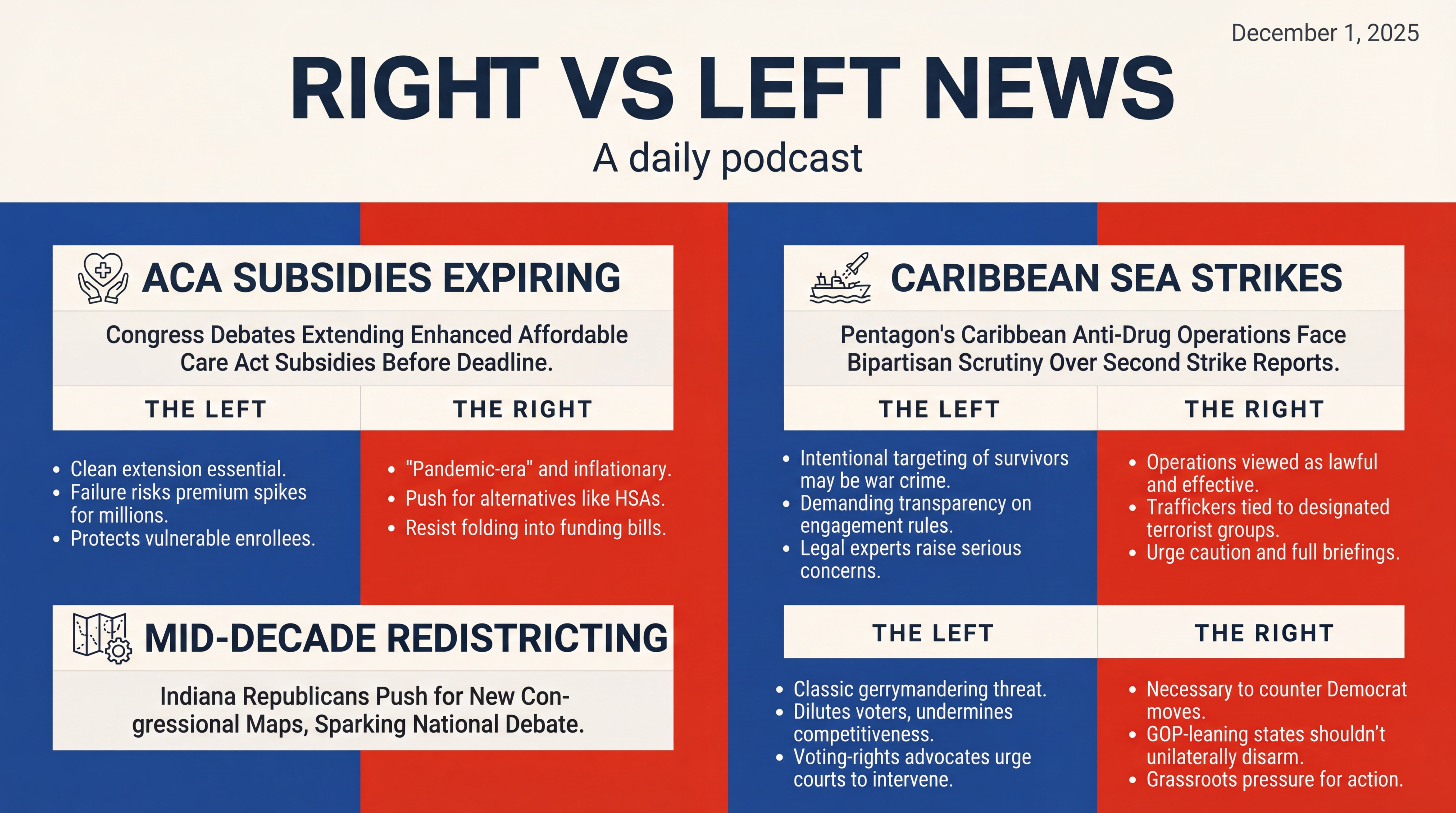
Episode Infographic
Show Notes
Welcome to Right versus Left News—your daily briefing on the stories that matter, told from both sides of the aisle. I'm your AI host - Chris, and each day I bring you the most important political and cultural news, with perspectives from conservative and progressive voices. No spin, no agenda—just the facts and the opinions that shape our national conversation. Let's dive in...
Today we’re tracking five big developments: a high-stakes fight over Affordable Care Act subsidies on Capitol Hill... a growing storm over reports of a second strike in a U.S. anti-drug operation at sea... two Supreme Court arguments — one on asylum reviews, another on internet liability for music piracy... and Indiana lawmakers opening a special session on mid-decade redistricting. Let’s dive in.
[BEGINNING_SPONSORS]
First up, Affordable Care Act premium subsidies. Republicans are weighing whether to extend the enhanced subsidies that expire December 31. There are divisions inside the party — some pushing for a short extension paired with bigger reforms, others resisting any renewal at all. Democrats want a clean extension, and the White House has sent mixed signals about a possible two-year deal. President Trump has expressed reluctance to extend the subsidies, while leaving the door open to a limited deal. House leaders have shown resistance to a clean extension.
Analysts warn premiums could jump sharply in 2026 without action. This same issue helped prolong last month’s shutdown, and it’s coming back for a December vote. Roughly 24 million people could be affected.
On the right, critics call the enhanced subsidies “pandemic-era” and inflationary. They’re urging alternatives like Health Savings Accounts, price transparency, and targeted changes — not another round of costly credits. House conservatives don’t want subsidies folded into funding bills, while some Republicans are floating a shorter extension with structural reforms.
On the left, the focus is affordability and coverage security. Progressive voices warn that failure to extend would spike premiums and push millions off insurance. Equity advocates say rural residents and older enrollees could be hit hardest.
Now to the Caribbean operation. President Trump says he believes Defense Secretary Pete Hegseth did not order the killing of survivors after a September 2 strike on a suspected drug-smuggling boat — but he’ll look into it. Bipartisan lawmakers are demanding records and briefings, and some warn any follow-on strike targeting survivors could be unlawful. Committees in both chambers are moving to review the operations.
On the right, coverage emphasizes the broader campaign, describing traffickers as tied to designated terrorist groups and asserting the operations are lawful and effective in constricting narcotics flows. Some Republicans urge caution and want full briefings before drawing conclusions.
On the left, legal experts warn that intentionally targeting survivors would violate the laws of war and could amount to a war crime. Democrats on armed services panels are pressing for transparency on rules of engagement and legal justifications.
At the Supreme Court, the justices hear Urias-Orellana v. Bondi. The question: when the Board of Immigration Appeals decides that undisputed facts don’t amount to “persecution” for asylum, must courts defer — or should judges review that legal conclusion anew?
The ruling could clarify how much deference agencies receive, after a term that’s shown skepticism of agency power. It could also standardize review across circuits.
On the right, analysts say applying statutes to fact patterns in asylum cases is intensely fact-based — and courts should be deferential to avoid micromanaging the executive’s case-by-case judgments. There’s support for curbing expansive judicial interventions in border policy and keeping clear limits on who has “arrived” for asylum processing.
On the left, commentators emphasize due process. They argue asylum seekers need consistent judicial review on legal thresholds like “persecution,” not rubber-stamping of agency findings. Many favor de novo review on mixed questions to prevent life-or-death errors.
[MIDPOINT_SPONSORS]
Also at the Court: Cox Communications v. Sony Music. The justices will weigh when an internet provider can be held liable for users’ piracy, and what intent is required for contributory infringement.
The case stems from a huge verdict that was later pared back on appeal. The Court agreed to revisit liability questions after the Fourth Circuit left contributory infringement intact. Tech outlets and filings preview arguments that imposing termination regimes based on accusations could cut off whole households or campuses from the internet. Civil-liberties groups warn that aggressive policing by ISPs could harm speech and access.
On the right, business and tech voices favor clear limits on secondary liability — arguing Congress, not courts, should set nationwide rules that avoid mass disconnections and heavy monitoring that could chill innovation. They warn a broad standard could punish providers for others’ misconduct.
On the left, many sympathize with artists seeking stronger remedies against large-scale infringement. But civil-liberties advocates caution that expansive liability could hurt lawful users and speech. Expect some progressive voices to split — some prioritizing creators’ rights, others prioritizing access and due process.
Finally, Indiana. The Republican-led legislature convened with redistricting top of mind, after pressure from President Trump to redraw the congressional map before 2026. House leaders are ready to move, while Senate Republicans have been divided — some previously said they lacked the votes to reconvene — but the Senate is slated to meet next week to consider any House plan.
This is part of a broader mid-decade map push by both parties in several states, with national House control at stake.
On the right, the argument is that GOP-leaning states shouldn’t unilaterally disarm while blue states pursue favorable maps. There’s grassroots pressure on reluctant Republicans to act, and accusations that Democrats are entrenching power elsewhere.
On the left, Democrats warn that a 9-0 GOP map in Indiana would be classic gerrymandering — diluting voters and undermining competitiveness. Voting-rights advocates are urging courts and public pressure to hold the line against mid-decade redraws.
Quick recap... Congress faces a December health-care decision that could hit millions of pocketbooks... the Pentagon’s Caribbean strikes face bipartisan oversight amid allegations of a fatal follow-on strike... the Supreme Court takes up asylum review and internet liability — two rulings with real-world consequences... and Indiana’s mid-cycle redistricting fight could echo nationwide. We’ll be watching what moves next.
That's it for today's episode of Right versus Left News. Remember, understanding both sides isn't about picking a team—it's about being informed. Subscribe wherever you get your podcasts, and join us tomorrow for another balanced look at the day's biggest stories. Until next time, stay curious and stay informed.