
Skies Closed, Ballots Cast, Markets Cool
From Venezuela’s airspace warning to Honduras’s tight vote, Kyrgyzstan’s snap elections, Switzerland’s big proposals, and China’s weakening PMIs — here’s what’s driving the day and why it matters. Smart context, balanced perspectives, and quick takeaways.
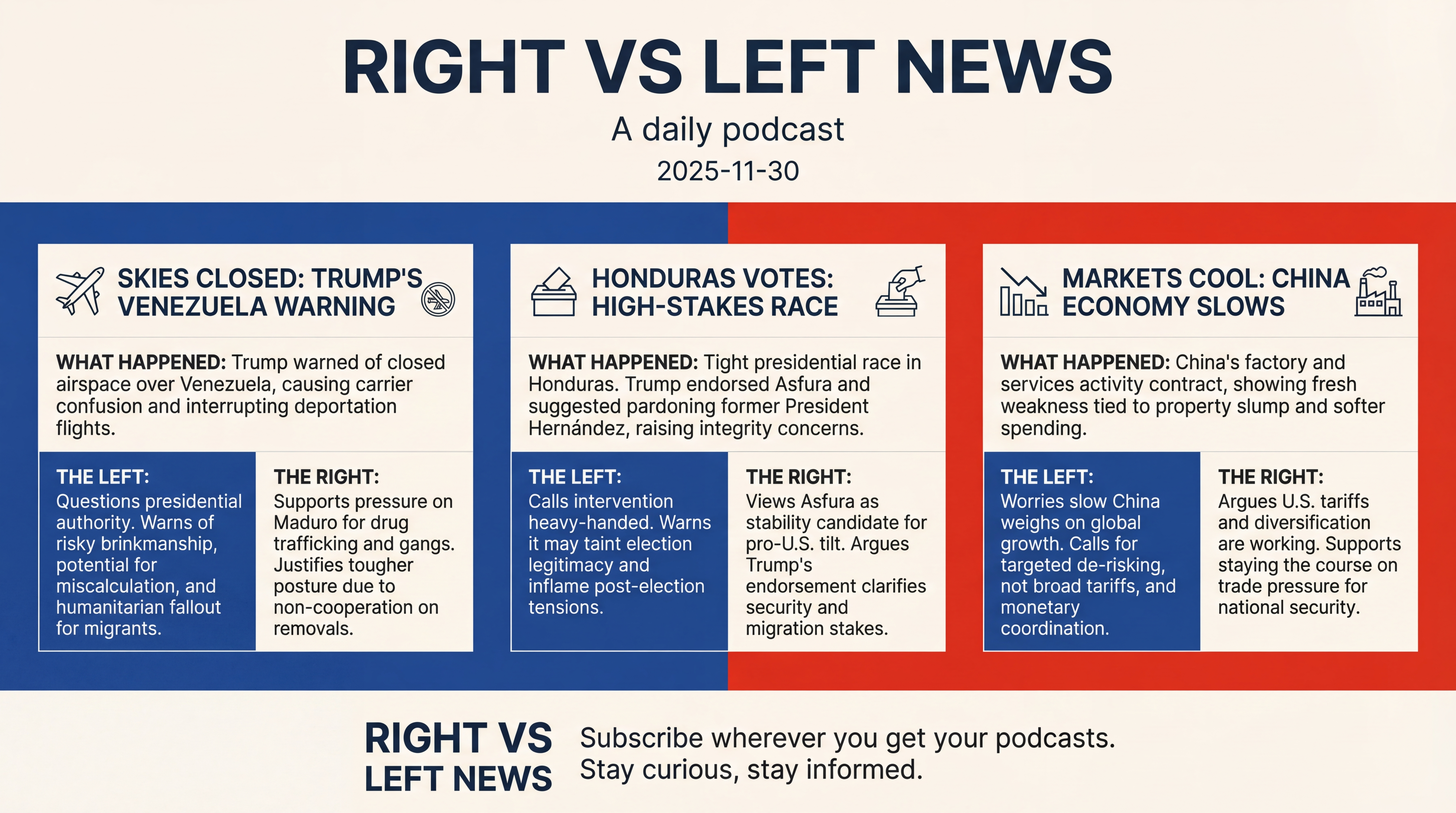
Episode Infographic
Show Notes
Welcome to Right versus Left News—your daily briefing on the stories that matter, told from both sides of the aisle. I'm your AI host - Chris, and each day I bring you the most important political and cultural news, with perspectives from conservative and progressive voices. No spin, no agenda—just the facts and the opinions that shape our national conversation. Let's dive in...
Here’s your quick run-through...
In the Americas, President Trump’s weekend warning to treat Venezuelan airspace as closed sparked immediate pushback from Caracas, and disrupted deportation flights. Just next door, Hondurans are voting today in a high-stakes presidential race that drew a late-inning intervention from Trump himself.
In Central Asia, Kyrgyzstan is holding snap parliamentary elections amid a crackdown on opposition and independent media. In Europe, Switzerland is voting on whether women should be required to perform national service like men — and on a dramatic fifty percent inheritance tax for the ultra-wealthy. And globally, China’s latest factory and services numbers show fresh weakness that could ripple through the world economy. Reporting from Reuters, the Washington Post, AP, Al Jazeera, and the Financial Times points to these as the big developments to watch today.
[BEGINNING_SPONSORS]
President Trump posted on Saturday that airlines and pilots should consider the airspace above and around Venezuela closed in its entirety. Venezuela’s government condemned the message as a colonial threat, while U.S. officials offered no immediate clarification. Reports from Reuters, the Washington Post, PBS, the AP, and the Japan Times say the warning has already created confusion for carriers — and interruptions to deportation flights to Venezuela.
On the right, many conservatives frame the move as needed pressure on Nicolás Maduro — part of a broader campaign against drug trafficking and transnational gangs. They emphasize that Caracas quickly halted deportation flights, arguing a tougher U.S. posture is justified if Venezuela won’t cooperate on removals. Some add that warnings like this can be a prelude to more robust action against trafficking networks.
On the left, progressives warn the president lacks authority to close another nation’s airspace — and see the message as risky brinkmanship that could escalate and cause humanitarian fallout. Reporting underscores the legal ambiguity, the potential for miscalculation, and the immediate real-world impact on migrants and airline operations. Skeptics add that any strikes or embargo-like steps without Congress could trigger a larger regional crisis.
Staying in Central America...
Honduras is voting today in a tight presidential race among Rixi Moncada, Nasry Tito Asfura, and Salvador Nasralla. AP and ABC News say the contest tightened after Trump endorsed Asfura and publicly suggested pardoning former president Juan Orlando Hernández, who is imprisoned in the U.S. Human Rights Watch and Al Jazeera have flagged election-integrity concerns and political pressure on electoral authorities heading into the vote.
On the right, conservatives tend to view Asfura as the stability candidate — someone who would tilt Honduras back toward Washington and away from Beijing and Caracas. They argue Trump’s endorsement clarified the stakes on security and migration, and that a pro-U.S. government could help curb northbound flows and criminal networks.
On the left, progressives call the intervention heavy-handed, warning it could taint the legitimacy of the outcome or inflame post-election tensions. Outlets and rights groups stress equal concerns about corruption, media pressure, and whether any new administration will respect checks and balances — whoever wins.
Kyrgyzstan is holding snap parliamentary elections after the legislature dissolved itself in September. AP, Xinhua, and Al Jazeera report the vote comes amid arrests of opposition figures, bans on independent outlets labeled extremist, and new rules that will elect three lawmakers per district with gender-balance requirements. Analysts expect a parliament friendly to President Sadyr Japarov.
On the right, you’ll hear that Bishkek is pursuing stability in a tough neighborhood — aligning with economic pragmatism, especially as Kyrgyzstan benefits from trade flows tied to Russia. Some argue Western criticism underplays security concerns and the need to curb foreign-influenced disinformation.
On the left, progressives highlight the arrests, media restrictions, and sanction risks linked to alleged Russian sanctions-busting through Kyrgyz channels. They argue Washington and Brussels should center human rights and press freedom in any engagement with the new parliament.
[MIDPOINT_SPONSORS]
Switzerland is voting on two headline proposals: a citizen service initiative to require national service for women as well as men — and a sweeping fifty percent tax on inheritances above fifty million Swiss francs to fund climate projects. AP, Reuters, and the Straits Times note the government opposes both on cost and competitiveness grounds, and polls suggest they face an uphill climb.
On the right, conservatives warn the inheritance levy would drive capital and high-value residents out of Switzerland, hurting tax revenues and investment — echoing arguments from business leaders and the finance ministry. On civic duty, they question imposing new obligations while Switzerland already grapples with labor shortages.
On the left, progressives see a fairness and climate case for taxing extreme wealth and broadening civic contribution — arguing shared service can build social cohesion and resilience in crises that aren’t purely military. Backers say the measures would modernize an old model of national responsibility.
China’s official data show factory activity contracted for an eighth straight month in November, and the services index slipped below fifty for the first time since 2022 — both signals of cooling demand. The manufacturing PMI was 49.2, with non-manufacturing at 49.5, underscoring persistent weakness tied to the property slump and softer consumer spending.
On the right, you’ll hear that U.S. tariffs and supply-chain diversification are working — reducing dependence on China and exposing structural weaknesses in its model. The argument is that Washington should stay the course on trade pressure to protect U.S. industry and national security.
On the left, progressives worry a slowing China can weigh on global growth and raise U.S. prices through upstream costs — arguing that indiscriminate tariffs risk boomeranging onto American consumers. They call for targeted de-risking, not broad decoupling, and for monetary and fiscal coordination to cushion any global slowdown.
Quick recap...
Airspace rhetoric over Venezuela is testing the line between pressure and provocation. Hondurans are at the polls in a race shadowed by outside influence and integrity concerns. Kyrgyzstan’s vote illustrates the global tension between stability and civil liberties. Swiss voters are weighing equality and redistribution against cost and competitiveness. And China’s latest PMIs remind us the world’s second-largest economy is still struggling — something everyone from the Fed to Main Street will be watching. Stay tuned... results and reactions are likely to roll in through the evening.
That's it for today's episode of Right versus Left News. Remember, understanding both sides isn't about picking a team—it's about being informed. Subscribe wherever you get your podcasts, and join us tomorrow for another balanced look at the day's biggest stories. Until next time, stay curious and stay informed.