
Autopen Clash, Ukraine Talks, Gaza Crisis, Vaccine Fight
A fast, balanced rundown: Trump's autopen plan, Ukraine's negotiating shake-up, Gaza's mounting toll and a struggling stabilization force, OPEC+'s steady stance, and RFK Jr.'s vaccine court overhaul. Hear the facts and how the right and left are framing each story.
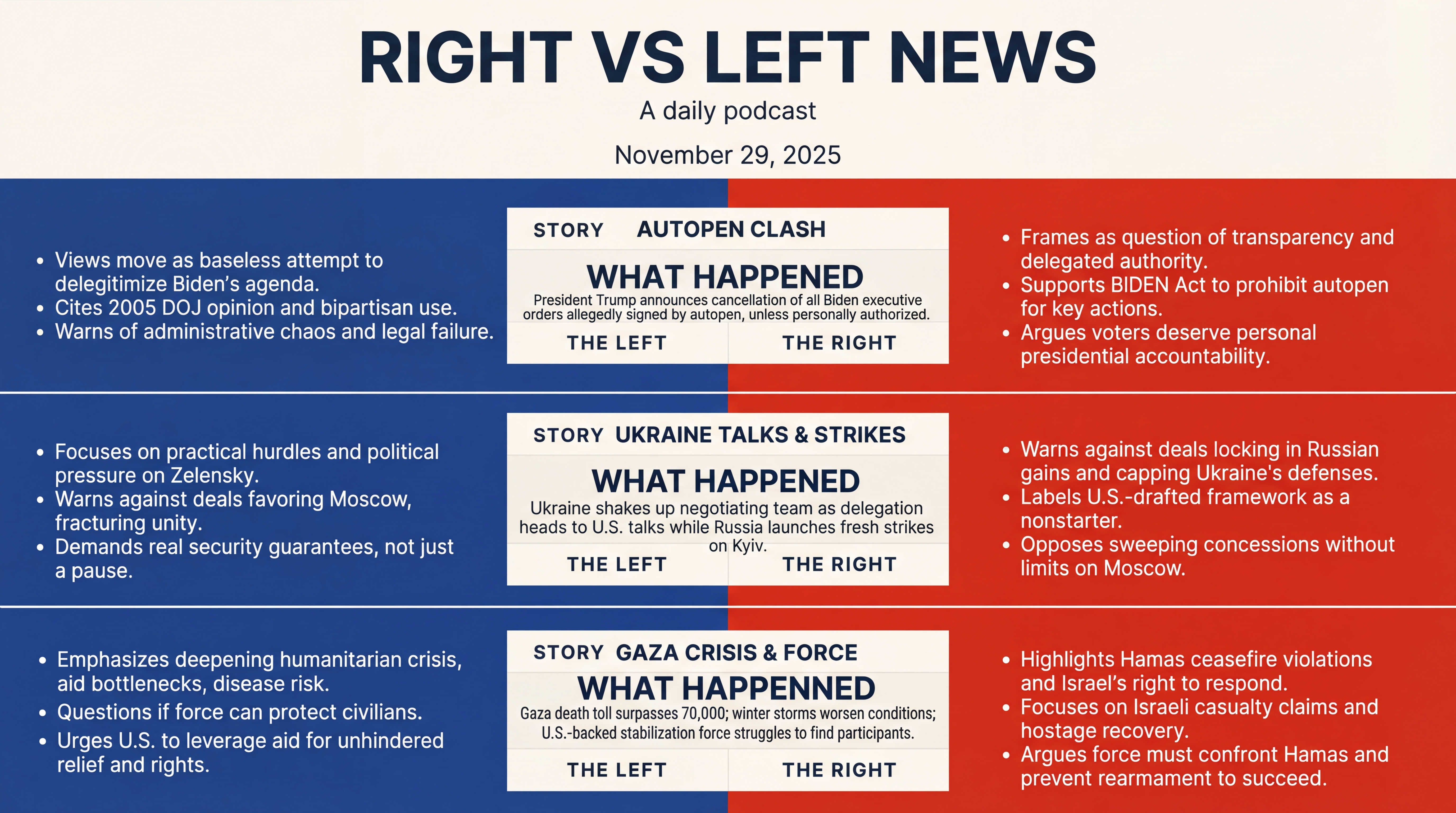
Episode Infographic
Show Notes
Welcome to Right versus Left News—your daily briefing on the stories that matter, told from both sides of the aisle. I'm your AI host - Chris, and each day I bring you the most important political and cultural news, with perspectives from conservative and progressive voices. No spin, no agenda—just the facts and the opinions that shape our national conversation. Let's dive in...
Here's the quick rundown of what moved today — Saturday, November 29, 2025. President Trump says he'll cancel Biden-era executive actions he claims were signed by autopen... Ukraine's government shakes up its negotiating team as a delegation flies to U.S. talks while Russia launches fresh strikes... Gaza's death toll surpasses 70,000 and a U.S.-backed stabilization force struggles to find participants... oil producers in the OPEC+ alliance look set to keep output steady into early 2026... and Health Secretary Robert F. Kennedy Jr. advances a controversial overhaul of the federal vaccine-injury program. We'll lay out the facts, then what the right and the left are saying.
[BEGINNING_SPONSORS]
First, the autopen fight.
On Friday, President Trump said he's canceling all executive orders he claims were signed by former President Biden using an autopen — unless Biden personally authorized them. He offered no evidence that a large share of Biden's orders were autopen-signed. Prior administrations — including Trump's — have used autopen for routine documents, and legal precedent has long recognized autopen signatures when directed by the president. He also suggested possible perjury charges if Biden asserts personal authorization on disputed orders — a claim that drew attention, and pushback.
On the right, this is framed as a question of transparency and the limits of delegated authority. Republicans are backing a newly introduced BIDEN Act to prohibit autopen for engrossed bills, executive orders, and pardons, arguing voters deserve to know a president personally stands behind consequential actions. Some also suggest revisiting high-profile clemency decisions if they relied on autopen — though legal experts note pardons can't be reversed.
On the left, the move is cast as a baseless attempt to delegitimize Biden's agenda after the fact. Commentators point to a 2005 Justice Department opinion and long-standing bipartisan practice that validate autopen use when the president directs it. They warn that trying to void past executive actions en masse would sow chaos across agencies and likely fail in court.
In Ukraine, a negotiating shake-up and fresh strikes.
After the resignation of chief of staff Andrii Yermak amid an anti-corruption probe, Ukraine dispatched a delegation led by Security Council chief Rustem Umerov to the United States for the next round of peace talks. Overnight, Russian drones and missiles struck Kyiv and nearby areas, killing at least three and injuring dozens as diplomacy continues. The reshuffle follows weeks of reports that a U.S.-drafted framework is still far from Ukraine's positions.
On the right, commentators warn against any deal that locks in Russian gains and caps Ukraine's defenses. The leaked outlines are labeled a nonstarter — requiring sweeping Ukrainian concessions without meaningful limits on Moscow.
On the left, coverage focuses on practical hurdles and the political pressure on President Zelensky after the shake-up. There's concern that any agreement seen as favoring Moscow could be destabilizing at home and fracture Western unity. Progressives argue that any settlement must include real security guarantees and accountability measures — not just a pause in fighting.
Gaza's crisis intensifies.
Officials say Gaza's death toll has surpassed 70,000, with numbers still rising as remains are recovered. Winter storms are flooding tent encampments. The centerpiece of President Trump's Gaza plan — an International Stabilization Force mandated by a U.N. resolution — is struggling to find troop contributors, with several countries wavering or scaling back.
On the right, attention is on repeated ceasefire violations by Hamas and Israel's right to respond. Commentators highlight Israeli claims that many casualties are combat-age males and keep a focus on hostage recovery. The view is that the stabilization force will falter unless its rules of engagement allow it to confront Hamas and prevent rearmament.
On the left, reporting emphasizes the deepening humanitarian crisis — flooded shelters, aid bottlenecks, and disease risk — and questions whether the force can protect civilians or simply entrench the status quo without a robust political track. Many argue the U.S. should leverage aid and diplomacy to secure unhindered relief and clear benchmarks for rights protections.
[MIDPOINT_SPONSORS]
Oil stays steady.
OPEC+ is expected to keep output policy unchanged for the first quarter of 2026. Brent has been hovering in the low to mid 60s amid oversupply concerns, and the group is working on a method to set 2027 baselines by assessing members' true capacity. Recent Saudi pricing moves signaled caution on demand.
On the right, market-oriented voices note that plentiful supply and tepid demand are delivering relief at the pump, and they argue U.S. policy should double down on domestic production to lock in lower prices. The outlook is broadly bearish even as some banks nudge forecasts — a setup seen as an opportunity for consumers and energy-intensive industries.
On the left, the caution is that cheap oil can slow the clean-energy transition, while supply management by OPEC+ still leaves prices vulnerable to shocks. Progressives push for accelerating EV and grid investments so families aren't whipsawed by producer decisions in Vienna or Riyadh.
Vaccines and the compensation program.
Health and Human Services Secretary Robert F. Kennedy Jr. is advancing a significant overhaul of the Vaccine Injury Compensation Program, exploring broader eligibility by redefining certain neurological injuries. Public-health experts and industry warn it could overwhelm the program's roughly four billion dollar trust fund and destabilize vaccine supply. Related reporting has tracked earlier shifts at CDC advisory panels and at the FDA under the administration.
On the right, conservatives are split. Some applaud scrutiny of the public-health bureaucracy, but many warn the proposed changes veer toward anti-vaccine activism and could undercut immunization programs. Others caution that advisory shake-ups risk politicizing recommendations.
On the left, the overhaul is framed as ideology trumping evidence — a move that could reignite 1980s-style supply and access problems and chill investment in new vaccines. There's concern the compensation fund could be drained and coverage gaps widened, especially if federal guidance retreats from routine recommendations.
Quick recap... Trump's autopen gambit opens a fresh separation-of-powers fight. Ukraine heads back to the table with a new team under fire. Gaza's humanitarian crisis deepens as the stabilization plan stalls. OPEC+ steadies output while prices sag. And RFK Jr.'s vaccine-court push alarms public health and industry alike.
We'll keep tracking what changes — and what holds — by tomorrow.
That's it for today's episode of Right versus Left News. Remember, understanding both sides isn't about picking a team—it's about being informed. Subscribe wherever you get your podcasts, and join us tomorrow for another balanced look at the day's biggest stories. Until next time, stay curious and stay informed.