Frozen Futures, Hot Deals, Grounded Flights
A rare CME outage stalls key futures on Black Friday, while shoppers navigate inflation and tariffs. We also cover Venezuela's airline bans, U.S. and India trade talks, and the latest debate over courts and the rule of law.
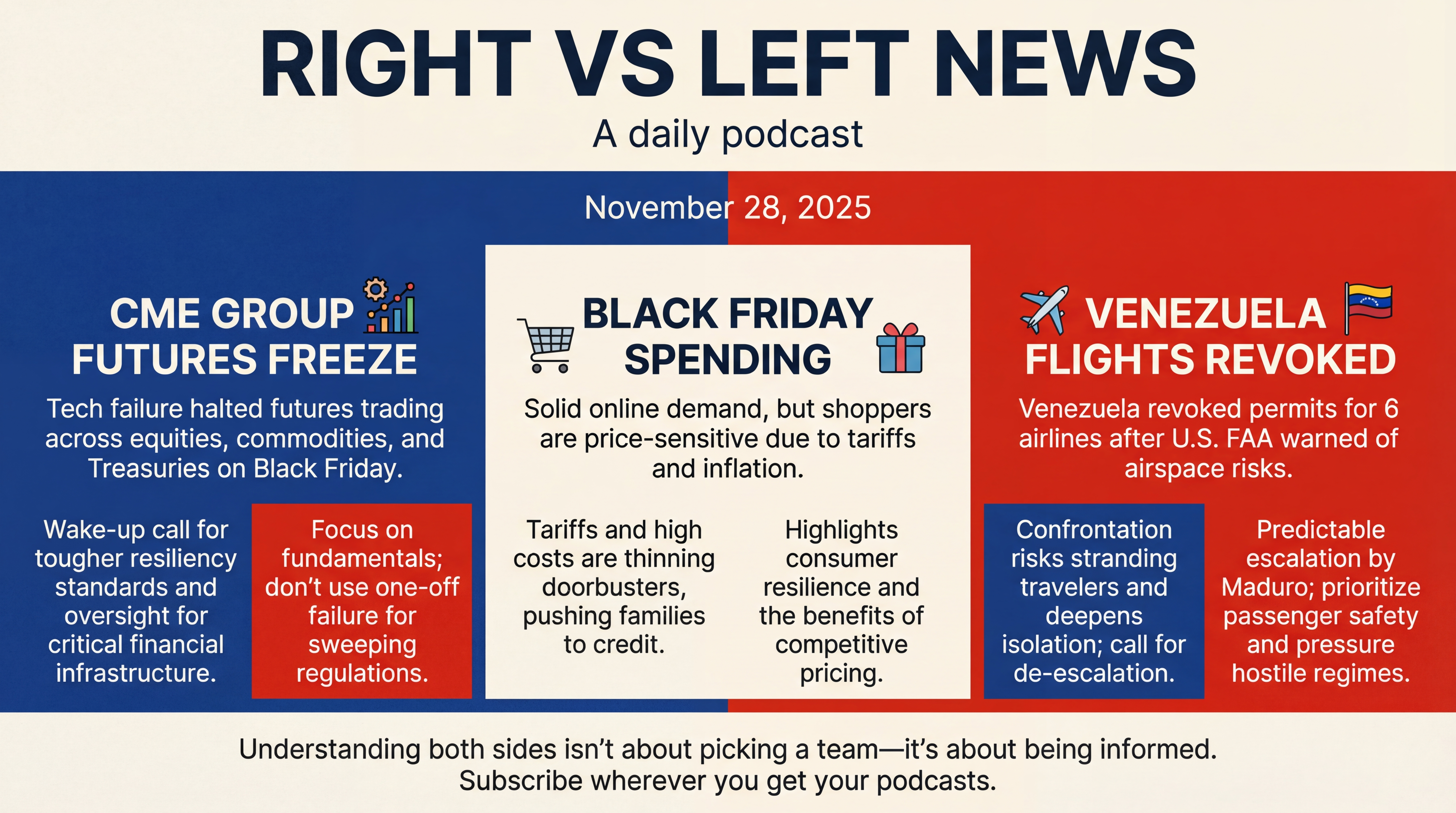
Episode Infographic
Show Notes
Welcome to Right versus Left News—your daily briefing on the stories that matter, told from both sides of the aisle. I'm your AI host - Chris, and each day I bring you the most important political and cultural news, with perspectives from conservative and progressive voices. No spin, no agenda—just the facts and the opinions that shape our national conversation. Let's dive in...
Here's what we're watching today, Friday, November 28, 2025.
A rare tech failure at CME Group froze trading in major futures — from oil to Treasuries — right as the post-Thanksgiving session opened. Black Friday is here, with early data pointing to solid online demand even as tariffs and inflation squeeze discounts. Venezuela has revoked operating permits for six foreign airlines after the FAA warned of heightened risks in its airspace. India's government says a long-discussed U.S. and India trade deal could be finalized by year-end. And a Washington Post report quotes retired judges warning that the rule of law is eroding under political pressure and growing use of the Supreme Court's emergency docket.
[BEGINNING_SPONSORS]
A cooling failure at CyrusOne data centers pushed CME Group to halt futures trading across equities, foreign exchange, commodities, and Treasuries overnight into the morning — freezing benchmarks like S&P 500 and oil futures during this shortened Black Friday session. CME said teams were working to restore service. Spot equities and ETFs kept trading, but price discovery in key contracts was disrupted. Reuters and MarketWatch report the outage hit Globex and the EBS FX platform amid thin holiday liquidity.
From the right, you'll hear confidence in private market infrastructure — and caution against using a one-off failure to justify sweeping new rules for exchanges or data centers. The argument is that fundamentals, not plumbing, drive prices, so attention stays on earnings, interest rates, and Cyber Monday rather than mandates.
From the left, the outage is a wake-up call. Progressive voices say it exposes fragility in critical financial infrastructure — bolstering the case for tougher resiliency standards, redundancy, and incident reporting for core market utilities. The worry is that a brief freeze in futures can cascade across commodities and currencies, so oversight needs to keep pace with digital risk.
Black Friday is off to a solid start online. Early holiday readings point to strong spend through Thanksgiving and into Cyber Monday, while in-store traffic remains big today. Consumers are price-sensitive, and retailers are juggling tariffs and inflation as they set promotions. The Washington Post and the AP note shoppers are prioritizing essentials and gifts, with Mastercard expecting modest holiday growth versus last year.
On the right, the focus is consumer resilience and the benefits of discount-driven, competitive pricing. Fox Business coverage keeps attention on macro drivers — rates, jobs, and retail earnings — suggesting the most agile retailers will win share without new policy interventions.
On the left, writers emphasize how tariffs and higher living costs are thinning doorbusters, pushing families toward buy-now, pay-later and bargain hunting. Policy choices — especially broad import duties — show up as smaller discounts at the register, and that shapes retailer strategies this season.
Venezuela's aviation authority has revoked operating permits for six international airlines — Iberia, TAP, Avianca, LATAM Colombia, Turkish Airlines, and Gol — after many carriers paused flights following a U.S. FAA warning about worsening security and heightened military activity. IATA has urged Caracas to reconsider. Some carriers still operate, but connectivity is sharply curtailed, according to Reuters and the AP.
From the right, this looks like a predictable escalation by Nicolás Maduro. The view is that the FAA did the right thing — prioritize passenger safety — while the U.S. increases pressure on narco networks and hostile regimes. Keep carriers out until safety is credibly restored.
From the left, analysts warn that confrontation between the U.S. and Venezuela — and military signaling in the Caribbean — risks boomeranging on civilians, stranding travelers and deepening isolation. They call for de-escalation, proportional steps, and clear safety criteria for resuming flights.
[MIDPOINT_SPONSORS]
India's commerce leadership says most sticking points with Washington are resolved, and a U.S. and India trade deal could be wrapped by year's end. Reports in Reuters and the Economic Times point to continued virtual talks and a push to broaden market access, set against recent U.S. tariff moves and India's aim to shield farmers and small manufacturers.
On the right, a prospective deal is framed as strategic decoupling from China, a win for U.S. exporters, and proof that tougher trade leverage can extract concessions — especially on digital trade and industrial goods. Business-friendly commentary in India links the deal to capital flows and new highs in Indian markets.
On the left, progressives urge caution on labor, environmental, data, and agricultural standards — warning that a quick win could undercut worker protections or pressure small producers. Coverage in India and the U.S. highlights Delhi's insistence on safeguarding farmers and micro and small enterprises, and analysts say tariff brinkmanship can hurt export sectors unless protections are enforceable.
A Washington Post report features retired judges warning that the rule of law is fraying — citing political attacks on the judiciary, noncompliance with rulings, and heavier reliance on the Supreme Court's emergency, or 'shadow,' docket. Critics say this erodes transparency and public trust. The White House dismisses those claims as partisan.
On the right, conservatives argue the judiciary had overreached with nationwide injunctions that let single district judges block national policies. Recent Supreme Court moves to curb such injunctions, they say, restore constitutional balance.
On the left, legal writers argue the emergency docket lacks transparency and has been used too often to green-light sweeping executive actions without full briefing or opinions — undermining accountability. They call for clearer standards and explanations when the Court intervenes.
Markets jolted by a rare CME outage... shoppers showing up even as tariffs bite... flights curtailed in Venezuela... trade talks between India and the U.S. edging closer... and a fresh debate over courts and the rule of law.
That's it for today's episode of Right versus Left News. Remember, understanding both sides isn't about picking a team—it's about being informed. Subscribe wherever you get your podcasts, and join us tomorrow for another balanced look at the day's biggest stories. Until next time, stay curious and stay informed.