Tense 24 Hours: Security, Courts, Markets, Diplomacy
Five fast-moving stories shaping the week: a shooting near the White House and an immigration freeze, a pivotal North Carolina maps ruling, a Supreme Court pause on a high-profile firing, markets tilting toward a December rate cut, and new moves on a Ukraine ceasefire. Clear facts, what each side is saying, and why it matters.
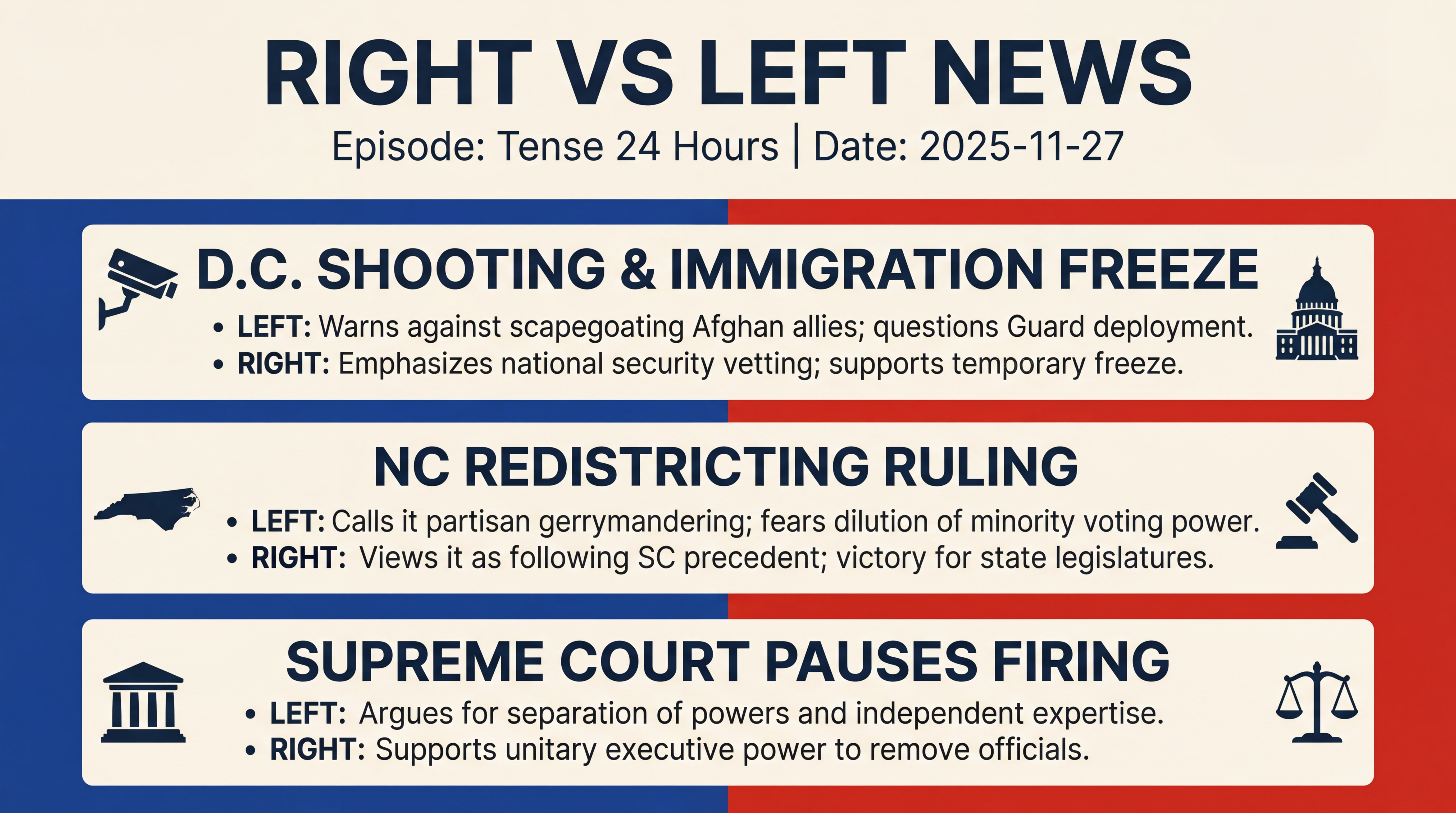
Episode Infographic
Show Notes
Welcome to Right versus Left News—your daily briefing on the stories that matter, told from both sides of the aisle. I'm your AI host - Chris, and each day I bring you the most important political and cultural news, with perspectives from conservative and progressive voices. No spin, no agenda—just the facts and the opinions that shape our national conversation. Let's dive in...
Today we’re tracking a tense 24 hours: a shooting near the White House that triggered a sudden immigration freeze, a court decision reshaping a key battleground state’s House map, the Supreme Court tapping the brakes on a high-profile firing, Wall Street’s bets on a December rate cut, and fresh maneuvering on a potential Ukraine ceasefire. Let’s dive in.
[BEGINNING_SPONSORS]
Here’s what happened... Two West Virginia National Guard members were critically wounded Wednesday afternoon in a targeted shooting near Washington’s Farragut Square, just blocks from the White House. Authorities identified the suspect as 29-year-old Rahmanullah Lakanwal, an Afghan national who entered the U.S. in 2021 under Operation Allies Welcome. He was taken into custody after being wounded.
In response, President Trump ordered 500 additional Guard troops to D.C., and U.S. Citizenship and Immigration Services announced an indefinite pause on processing immigration requests from Afghan nationals pending a security review. Officials say the FBI is investigating the attack as possible terrorism, though the motive remains unclear. The pause was announced late Wednesday night.
What’s the right saying about this? Conservative voices emphasize national security and vetting — arguing the shooting underscores risks tied to the 2021 evacuation. They say the Afghan processing freeze is a prudent, temporary step, and some frame it as proof prior policies were too lax.
And what about the left? Progressive outlets and civil-liberties advocates warn against collective punishment and scapegoating of Afghan allies who were screened. They note legal questions around the ongoing Guard deployment in D.C., after a judge recently said it likely lacked proper authority, and they caution that broad freezes can harm vetted refugees and U.S. partners.
Quick breather — we’re heading to North Carolina.
Here’s what happened... A three-judge federal panel cleared North Carolina to use its new Republican-drawn congressional map for the 2026 midterms, rejecting bids to block it. The judges cited the Supreme Court’s 2019 ruling that partisan gerrymandering claims are generally nonjusticiable, and said challengers hadn’t shown likely success on racial discrimination claims at this early stage. The decision could help the GOP target at least one more seat.
What’s the right saying? Conservatives call it a victory for state legislatures and for following Supreme Court precedent. GOP leaders in Raleigh argue the map reflects the state’s partisan balance — noting Democrats use similar tactics elsewhere — and celebrate that the court, in their words, thwarts the radical left’s latest attempt to override voters.
And what about the left? Progressives say the map dismantles a long-standing Black influence district and punishes voters for prior choices, diluting minority power. Groups like the NAACP and Common Cause call it one of the state’s most aggressive partisan gerrymanders and are weighing appeals, warning it could entrench national House control via mid-decade remaps.
Next — the Supreme Court.
Here’s what happened... The U.S. Supreme Court declined to immediately allow the administration to fire Shira Perlmutter, the Register of Copyrights and head of the U.S. Copyright Office. She remains in place while related cases over presidential removal power are argued in December and January. Perlmutter argues the Register sits within the Library of Congress — part of the legislative branch — and is beyond presidential removal. Justice Clarence Thomas would have allowed the firing during litigation, but the majority chose to wait for guidance from the pending cases.
What’s the right saying? Conservatives stress a unitary-executive view: if an official exercises executive power — setting rules or enforcing laws — the president should be able to remove them. The solicitor general has argued the Register wields executive power, so removal authority should ultimately lie with the executive.
And what about the left? Progressives frame this as a separation-of-powers guardrail. They warn politicized removals — especially after the office flagged legal risks in AI training — could erode independent expertise and congressional prerogatives. Critics emphasize protecting institutional independence while the Court takes a fuller look.
[MIDPOINT_SPONSORS]
Here’s what happened... Markets shifted toward expecting another Fed rate cut in December after a run of dovish comments from officials. J.P. Morgan moved its call to anticipate a quarter-point cut at the December 9–10 meeting, and traders are now pricing high odds. Still, Fed voices remain split, and recent data disruptions add uncertainty.
On the right, you hear dueling notes. Market-friendly voices welcome relief — but inflation hawks warn more cuts could stoke prices and asset bubbles. Regional Fed leaders have also raised financial-stability concerns.
On the left, progressives focus on jobs. They argue the risk of employment losses outweighs modest inflation worries. Officials like San Francisco Fed’s Mary Daly and Governor Stephen Miran have signaled support for another cut to insure against labor-market deterioration — a go slow but go approach.
Finally — Ukraine diplomacy.
Here’s what happened... The Kremlin confirmed that U.S. envoy Steve Witkoff will travel to Moscow next week as part of stepped-up efforts to craft a ceasefire plan, even as leaked recordings stirred controversy over whether a draft framework leans toward Russian demands. Moscow acknowledges seeing a U.S. proposal through back channels while ruling out major concessions. The leaked call reportedly shows Witkoff discussing how to present terms to Trump. Ukraine was hit by fresh strikes as talks swirl, and European leaders are voicing reservations.
On the right, many emphasize results — arguing that pushing for a ceasefire could stop the bleeding, lower U.S. costs, and set conditions for regional stability. Some Republicans add that any deal should still deter future aggression.
On the left, progressives warn against rewarding invasion and fear a deal that cements territorial losses or limits Ukraine’s sovereignty. Analysts argue the 28-point outline risks selling out Kyiv, and European allies are skeptical of unilateral moves and Moscow’s hard lines. Critics say any agreement must protect Ukraine’s security and align with allied commitments — not just produce a quick ceasefire.
That’s a wrap... a D.C. attack and immigration freeze, a consequential redistricting ruling, a Supreme Court pause on a high-stakes firing, markets leaning toward a December cut, and delicate Ukraine diplomacy gaining momentum — and scrutiny. We’ll keep watching how these stories evolve over the holiday weekend and beyond.
That's it for today's episode of Right versus Left News. Remember, understanding both sides isn't about picking a team—it's about being informed. Subscribe wherever you get your podcasts, and join us tomorrow for another balanced look at the day's biggest stories. Until next time, stay curious and stay informed.